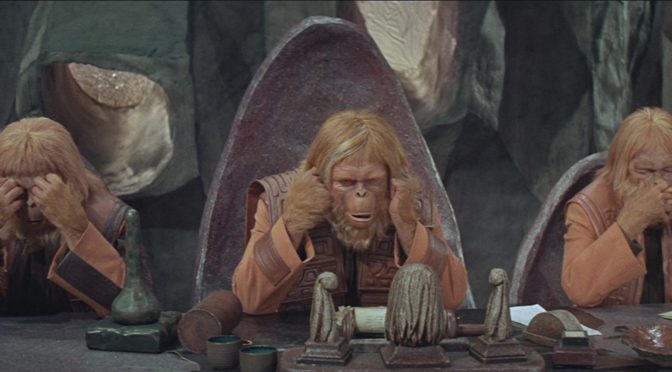
Fifty years ago today, Planet of the Apes was released in theaters. Filmgoers were presented with an alternate future where humans were no longer the dominant species. No longer the strongest. It took audiences by storm and produced four sequels, two television series, numerous graphic novel adaptations, and a remake. Not to mention the recently popular film saga. What is it about this simple sci-fi story that has resonated with our culture for 50 years?
I had never seen the original film until this year in preparation for this article. I have seen all of the new films and have enjoyed most of them but I was honestly surprised how relevant the original still is 50 years later. I believe it worked so well because it held up a mirror to our culture and allowed us to reflect on our actions and behaviors in the light of what really matters to us as a species.
The original 1968 movie mixes political and religious satire, suspense, and action and leads us to a finale with one of the best twists in all of film history. If you don’t know what that twist is then please stop right here and let me express to you that you have an amazing gift right now. Please don’t read any further. Go find a copy of the film (but beware of some of the DVD covers that can even spoil the ending!). There is a new 50th anniversary Blu-ray edition being released this week and you can get it for $8 over at Best Buy. It has the film plus a digital copy and all of the special features that you could want. Enjoy the camp and get swept away to a time when political powers were unstable, the future was uncertain, and the threat of nuclear war was on the public’s mind daily. Even sarcastically you can see how this film still speaks its humanist message loud and clear.
Continue reading Planet of the Apes (1968) – 50th Anniversary



 Fred Zinnemann is one of the great forgotten directors, which is amazing considering that he was nominated for eight directing Oscars in four decades and won two. We don’t hear today’s directors idolizing him or many critics championing his work. You will probably never read about him in “Entertainment Weekly.” For Zinnemann, the script is king, and his greatest genius may have been in choosing the right scripts and knowing how to do them justice.
 Paul Scofield plays More in such a way as to make us not only admire him but identify with him. As we watch, we come to value both his humanness and his spirituality. His tired eyes, the way he gently rebuffs his opponents, his genuine professions of loyalty to Henry even as he disagrees with the matter of his divorce, all help to create a character so well-rounded and illuminating that we find him to be better company than the people we meet in real life. It’s a gift the movies seldom actually deliver on, so when someone like Scofield makes it happen, we respond with admiration and gratitude.