The Most Surprising Plot Twist Or Ending
This is a really fun topic to think about. On the other hand, it is an extremely hard one to write about. I want to tell you about all these films that have an excellent plot twist but I don’t want to give away what that twist is just in case someone hasn’t seen it. So, consider this your warning. There will be tons of spoilers ahead. I could not choose just one film without giving some honorable mentions. So I will give you my top-5 plot twists or endings. I hope you will join in the discussion and let me know your favorites in the comments below.
 |
5) The Sixth Sense (1999) This film has the most talked about twist of all time. I doubt that there is anyone reading that doesn’t already know about the twist that gave director M. Night Shyamalan his trademark. There are almost no clues in the film, showing us that Bruce Willis’ character is actually dead from the start, besides the alienation with his wife. The Sixth Sense was a tremendous crowd-pleaser, and that was its real success. Looking back over ten years later, I can’t overlook the plot holes, like how he entered houses and other metaphysical questions. That being said, this movie was extremely entertaining and helped to reinvent a whole genre. |
| 4) The Others (2001) This movie combines the right direction, script, editing and performances, all for the sake of the final twist. It borrowed some elements from The Sixth Sense, and it sets you up right from the very beginning. It seems like a simple plot that we’ve seen countless times, the haunted mansion, the children seeing ghosts. And it lulls the audience into a sense of complacency with the film. But as the film marches to the end, everything gets flipped on its head, and the ending is a total shock. And afterwards you think, why didn’t I see that coming? This movie is based on a main concept we’d never seen before. We saw things from a ghost’s point of view. |
 |
 |
3) The Usual Suspects (1995) What can I say about this movie that hasn’t already been said. It has a tremendously well-written script and Kevin Spacey is remarkable as Verbal Kint. But could he be Keyser Soze? Was the whole thing made up just to get the police off their tail? The plot makes you want to see the movie again and again to look for clues. After several times however, some revealing plot holes open up. But all that does is provide more fodder for discussion with all your fellow movie watching friends. Because they can all be interpreted differently by each viewer. But that’s the magic of the movie. It’s not just the final twist, but that final twist is great to the point that I want to buy this minimalist movie poster made in honor of the film. |
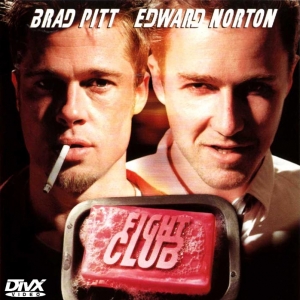
| 2) Fight Club (1999) Just how twisted and disturbed is the Narrator? When we finally realize that Tyler Durden is just a figment of his fractured imagination, an alter ego that personified all the qualities he lacked, you can’t help but admire the way all the events where presented to us. And upon a second or hundredth viewing, there are clues dropped throughout the movie. The single frame shots of Tyler that appear as his personality starts kicking in, the long, and gorgeously written, monologues of the Narrator, the attitude of Marla and other supporting characters. This movie almost completely failed at the box office. I was a junior is High School when it came out and I never heard of it. It was labeled as a product of a violent culture that leads kids in trench coats to bring guns into their schools and kill innocent people. Fight Club is a disturbing movie, but it is honest and real. This twist has an actual meaning unlike most films that just entertain, this one leaves you thinking. I couldn’t bring myself to make it number 1 because of the quality of that champion and because this one will appear again in my 30 day challenge and I was determined not to have any repeats. |
 |
 |
1) Psycho (1960) When you look up “Horror Film” in the dictionary, this picture of Janet Leigh screaming should appear next to it. I believe that Psycho is the greatest horror film ever made. It’s hard to find anything wrong with it. When watching an older movie, you have to put yourself in the mindset of someone from that period. One of the reasons the shower scene became so notorious was that the elements of sexuality and murder were ground breaking. In 1960, seeing a nude women being murdered in a shower was something that no-one had experienced yet. Nowadays, seeing Jason double-spearing two lovers having sex is nothing uncommon. Also, because Janet Leigh was the headliner of the film, no one expected to see her die so early on. After that scene, then the real movie began, and we get a glimpse into the disturbing world of Norman Bates, a man who loved his mother a bit too much. I envy those who experienced Psycho in 1960… in the theater… they experienced the full terror of Psycho. |
Well, there it is. Oh yeah, I had a few others that ended up just outside the top 5. I think of A Beautiful Mind, Memento, The Prestige, and Saw. Do you agree? Disagree? Let me know. This is way more fun when you talk back. Leave your comments below or on Twitter or Facebook.
 I am six days into the 30 Day Movie Challenge and I have remained faithful. But today presents a couple of obstacles. First, it is Wednesday and this is the one day a week that I take my kids to school. I choose Wednesday because that is Chapel day and I can sit with them as they sing and dance. It reminds me of an opening rally at VBS. I am writing this as I wait for chapel to begin, but this will delay me from my blogging time until about 10am. Add to that the very obscure topic for today, and it really does present a challenge.
 I Know My Name is Steven was one that looked interesting, also
  The story-lines involving Porter’s customers and how their lives were changed by him are certainly inspiring, but one must also wonder if they actually did happen. I was most intrigued by the story-line involving the gay couple and an obvious insinuation that one of their friends might have been afflicted with the AIDS virus. This was never resolved and seemed a little misplaced. Also, what is probably the films most quotable line, “God created us all, Shelly. He doesn’t make mistakes,” is in relation to this couple. The fact that this little bit of tolerance propaganda was tagged on kept this from being a really great film. But it doesn’t keep Door to Door from being a really an inspirational story that I still recommended for those who are sick movies about things getting blown up or people getting peppered with bullets.
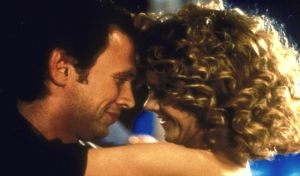
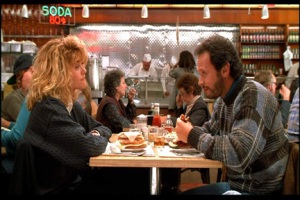 I can’t say that I’m an expert on romantic novels or films. I’ve seen my fair share, but I am not as fond of this genre as some others may be. That being said, I believe that When Harry Met Sally is, the wittiest and most funny romantic comedy out there in film land. The movie came out in 1989, but for some reason, I think this is one that will stand the test of time and entertain audiences for decades to come.
 Their love story is one that we’ve seen play out on the screen dozens of times since, but I don’t think any film has ever or will ever portray the issue better. The question it poses is one of universal importance, namely, can women and men ever be friends? It appears so, but what happens when you introduce sex to the equation? Does it negate the friendship or does the intimacy make it too awkward to continue just being friends? I’ll leave that for you and your friends (male or female) to discuss over a nice cup of coffee. If you haven’t seen the film, go now and watch it. Seriously, I will wait right here. If you won’t go watch it, I’ll just say that with heaps of quirky, funny dialogue, a script that Nora Ephron will forever attempt to duplicate, and clean directing from the extremely talented Rob Reiner, When Harry Met Sally is a highly enjoyable film that has held strong over two decades after its creation.
 In contrast to many of the weeping romantic comedies and melodramas that I mentioned in yesterday’s
  I don’t watch movies that make me sad. The reason most people watch movies is to escape for a couple of hours from your life. Who wants to escape to a sad alternate reality? On the other hand, there are plenty of movies with sad elements or scenes that make me cry no matter how many times I watch them. Yeah, that’s right I cry at movies. But that sadness is usually part of an ultimate happy ending or uplifting message.
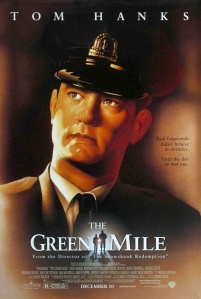 To narrow it down, I thought of 5 sad movies that I had seen. Those 5 were: My Girl, Boy with the Striped Pajamas, Dead Poets Society, A Walk To Remember, and The Green Mile. The saddest movie that I could think of was The Green Mile. At John Coffey’s execution everyone is weeping at seeing something so unjust. Everything from the scene where Paul goes into John’s cell and asks him what he wants him to do is sad. He can’t bear the thought of killing “one of God’s true miracles.” He doesn’t want to stand before God at the judgment and have to answer for why he killed an innocent man. Then as John asks to see a movie, he sits amazed at the beauty that he is beholding. At the execution I have to stop myself from sobbing out loud. Even the ending when we see Paul as an old man grieving over the loss of a friend saying that this is his punishment killing John Coffey. For those that think Stephen King is only a horror author, this film is the answer to that.
 If we’re going off of pure funniness, then the winner would be Blazing Saddles. I must admit that I saw this movie at much too young an age. I was a latch-key kid, spending several hours alone at home every night after school before my Mom and Dad got home from work. That gave me time to explore my parent’s collection of films. I probably saw this before I turned 12, but growing up in a town that is still to this day visibly divided by the railroad tracks, I understood the racial dynamic. I probably shouldn’t have been allowed to see it till High School, but I don’t think I was irreparably damaged. This is one of those films that has entered my vocabulary, one that my dad and I quote back and forth… “What’s a dashing urbanite like you doing in a rustic setting like this?”… “They darker than us!”… “Oh, lordy, lord, he’s desperate! Do what he sayyyy, do what he sayyyy!” Even though this film contains innumerable racial slurs, I think the point (if it has a point) is really about racial equality. The film is also quick to make references to other films and actors to make some of its gags. And since this was one of the few comedies in that home video library, I would watch it over and over again and was forced to do research on some of the jokes (Hedy Lamar, Randolph Scott, Cecil B. DeMille). Because of that, I owe a great deal of my love for film to this movie because it started me digging into the film industry.
 Standing in stark distinction to Blazing Saddles, I didn’t see The Princess Bride until I was in college. It is a movie that my kids have already seen and is also tremendously quotable. It has everything; action, adventure, humor, pirates, torture, and of course, true love. Cary Elwes delivers the most outstanding performance of his career as Westley, the love-struck servant to Buttercup (Robin Wright), a beautiful woman living in a misty romantic fantasy world. She also gives one of the best performances of her career in her film debut here as Princess Buttercup. The thing that makes this movie so great is the quality of comedy relief of the entire supporting cast. Wallace Shawn is absolutely hilarious as Vizzini, the bonehead villain who is completely convinced that he has the whole world figured out, Andre the Giant delivers a lumbering but highly impressive performance as Vizzini’s enormous, idiot sidekick, and my personal favorite, Mandy Patinkin creates one of the most entertaining and likeable characters to ever see the screen. “My name is Inigo Montoya! You killed my father! Prepare to die!”
 Fred Zinnemann is one of the great forgotten directors, which is amazing considering that he was nominated for eight directing Oscars in four decades and won two. We don’t hear today’s directors idolizing him or many critics championing his work. You will probably never read about him in “Entertainment Weekly.” For Zinnemann, the script is king, and his greatest genius may have been in choosing the right scripts and knowing how to do them justice.
 Paul Scofield plays More in such a way as to make us not only admire him but identify with him. As we watch, we come to value both his humanness and his spirituality. His tired eyes, the way he gently rebuffs his opponents, his genuine professions of loyalty to Henry even as he disagrees with the matter of his divorce, all help to create a character so well-rounded and illuminating that we find him to be better company than the people we meet in real life. It’s a gift the movies seldom actually deliver on, so when someone like Scofield makes it happen, we respond with admiration and gratitude.


 There is almost too much to say about these three films. In fact, only one film in the trilogy actually made it onto the IMDB Top 250 list, that being the final film, Red. Although these are each excellent as stand-alone works, they are best when seen as a whole. For that reason, I am going to review each of them separately. For the unfamiliar, Polish director Krzysztof Kieslowski’s last work, “Three Colors Trilogy” takes its name from the colors of the French flag and its themes from the ideals represented by those colors: blue (liberty), white (equality), and red (friendship).
 White is the second film in Kieslowski’s Trilogy, and it deals with the idea of equality. In my opinion, it may not be the strongest “film” of the three, but it is the one that I enjoyed the most. It maintains a balancing act between comedy and tragedy. The tone and feel of White was different, almost to the point of feeling out of sync, from the entire trilogy. The lead character is male unlike the other two films, even though Julie Delphy technically gets top billing, she only appears in about 15-20 minutes of the film. Polish actor, Zbigniew Zamachowski (Now you know why Delphy’s name was on all the promotional material!), puts in a powerful performance that goes from comedic pantomime to heartbreaking despair. Finally, White is told in a very plain way when you consider the imagery of Blue or the wonder of Red. White is simply less artsy, which is probably why I enjoyed it so much. Sometimes, forcing myself to sit through artsy films is like making my kids eat their vegetables, they don’t really want to do it, but they are good for them. I think most moviegoers could use a good dose of eating their cinematic vegetables and cut back on some of the “junk food,” but that is a post for another day.
 He is forced, in the courtroom, to use a translator because his French is weak, this only adds to the feeling of his impotence, he can barely even stand up for himself. She testifies that she no longer loves him, and he pleads with her to come back to Poland with him. But after we see Juliette Binoche poke her head in the courtroom (a tie-in from Blue). The divorce is granted, and Karol is on the streets with all his possessions in a big suitcase. His bank account is frozen and Karol can do nothing but watch as a bank employee cuts up his card. And as if that weren’t enough, she also frames him for arson. Unfortunately, there is no background given to Dominique’s character to reveal why she has such hatred for Karol. We see images of her smiling face at their wedding, but besides that, she is merely painted as an evil character.
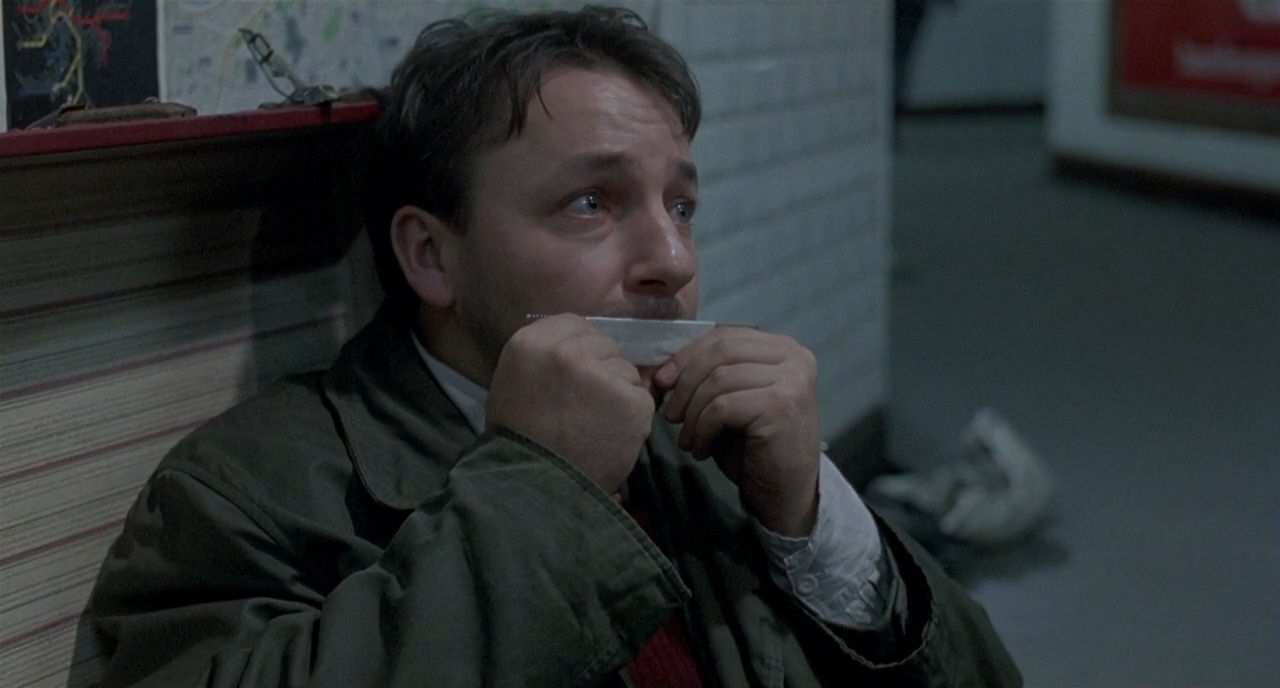 Now homeless and penniless, he takes to playing “music” on a comb in the train station in hopes for a handout. While playing a Polish folk song, he catches the ear of one of his countrymen named Mikolaj. They strike up a conversation about how he got in that situation and Mikolaj offers to pay his way back to Poland, but he cannot leave the country in such a public way because the authorities are still looking for him. So they come up with the plan that he should stow away in the suitcase, and leave behind the alienation and isolation of France. This seems like a strange way for a French financed movie, in a series about the French national colors, on the topic of equality to begin. I wonder if Kieslowski didn’t harbor some feeling of alienation against his adopted country, himself being Polish like the lead character. Mikolaj agrees to this plan and hopes that his new friend can survive the four-hour flight crammed inside a suitcase with a few personal belongings and a stolen bust that reminds him of Dominique, who he still loves.
 However, once the plane lands in Warsaw, in an unsurprising but hilarious twist, Mikolaj learns that the luggage has gone missing. We then catch up to Karol in a garbage dump outside Warsaw, where some luggage thieves have inadvertently taken him, probably thinking the weight of the bag was a good indicator of the value of its contents. Of course, they try to rob him, but besides the stolen bust (which they break) and two francs which he fights for, he has nothing for them to steal. Perhaps out of pity, they beat him, but do not kill him, and then leave him lying in the snow. Karol struggles to lift his now bloodied face and looks out to see the white snow swept garbage dump and says, “home at last!”
 Then with the help of Mikolaj and a trusted employee of his new company, Karol fakes his own death and leaves his fortune to Dominique. When she comes to Warsaw for the funeral, he sneaks into her hotel room and, after the initial shock, they make love, finally consummating their relationship. However, in the morning, Dominique awakes to the police at her hotel room door, but Karol is gone and despite her pleading in French that he is alive, Dominique is arrested for Karol’s murder. At the end, we see Dominique signing to Karol through the window of the prison in which she is being held. She tells him that she still loves him and is willing to marry him again, if she can get out of prison. Karol begins to cry. He has succeeded in achieving equality with his ex-wife, but it is a bittersweet victory. This film is not uplifting like Blue or Red it is a dark comedic tragedy.
 If you remember in Blue, Julie is so absorbed in her own emotions that she doesn’t even notice the old woman and the recycling bin. But she also shows up in White while Karol is shivering on the streets of Paris. Karol notices her but only grins as she tries to put her bottle in the bin. I tend to think that Karol is happy to see someone to whom he finally feels equal. Finally, this is the odd man out of Kieslowski’s trilogy, because it is less artsy and more straight-forward it makes a good introductory film to get into Kieslowski’s work. But even though the ending seems like a hopeless tragedy, the true ending of White is actually revealed at the end of Red, where we see Karol and Dominique have reconciled and are re-married.
 Blue, the first of the trilogy, takes place in Paris. It stars
  Because of its name, Blue, you can’t help but look for that color in the film’s carefully crafted images. With his expert usage of color, Kieslowski has forced the audience to pay attention to the slow-moving story that is unraveling on the screen. The most noticeable visual technique would be the odd fade-out/fade-ins that occur four times in the film. At each of the four points, Julie is at a crossroads, having to decide whether to push back the memories of her life before the accident, or to acknowledge them.
 At one point, she immerses herself completely and stays underwater for as long as possible. But soon, she has to come up for air. In the same way, Julie can’t help but re-establish the connections with her past, and like the continent upon which she resides, she shifts from a state of liberty into a state of union. She gives the family home to her husband’s mistress’, completes her husband’s unfinished composition, and even builds a relationship with Olivier.