A Movie That Disappointed You
 You would think that with 20 years to work on a worthy follow-up to the Indiana Jones Trilogy that Steven Spielberg and his collaborator George Lucas could create an entertaining and exciting film. However, it seems that instead of becoming sweeter with time, this one just became rotten. In Indiana Jones and The Kingdom of the Crystal Skull, we see an elderly Indy (or should I say Henry because he is rarely called “Indiana” or “Indy” in this film) in his baggy grandpa pants with locks of grey-white hair peeking out under a crisp and rarely-dirty brown fedora you really don’t get the feeling that you’re watching anything historic. This is a movie that obviously misunderstood its audience, it’s exactly the type of summer blockbuster developed to make money at all costs: things blow up; there are aliens; and an unnecessary youthful sidekick.
The film tries too hard to convince its audience that it’s set in the 1950s. You have Russian spies, nuclear testing, Howdy Doody, and Communist blacklisting all in the first act of the movie. While the earlier Jones films were an attempt to capture the magic of 30s and 40s adventure films, this one is an attempt to capture the feel of a 1950s action romp. You have campy dialogue, Shia LaBoeuf playing the Fonz, and a run-of=the-mill soda fountain brawl that plants this film in that era. In the previous Indy films, even with their date stamps, the adventures that took place are universally exciting and timeless.
 The other aspect of the film that disappointed me was the role that extra-terrestrials play. The original trilogy uses religious artifacts as the treasure the Indy is hunting. But as with the abominable Star Trek prequels that George Lucas thrust upon audiences, all of the religion and mysticism was replaced by science-fiction. Why don’t film-makers understand that audiences want to encounter something inexplicable in the theater. We don’t want midichlorians to give a scientific explanation of the force or science to replace our religion. The presence of the aliens is strong, but there is no dialogue between the two parties, much like Spielberg’s Close Encounters of the Third Kind.
The adventure sequences are hit-or-miss. Some of the car chases and fight sequences are good, and a lot of the side jokes are on the mark, but there are times that it’s hard to follow what’s going on as they try to pack too many characters and subplots into a fast-moving sequence. Ultimately, there are too many diversions like the plausibility of surviving a nuclear explosion by climbing in a refrigerator, the CGI prairie dogs, and Mutt’s own private army of monkeys. Dr. Jones doesn’t get very much solo screen time. Everyone around Henry seems to have become more like Indiana Jones, while he has become more cautious in his old age.
 Ultimately, Indiana Jones and the Kingdom of the Crystal Skull is a film that, while not entirely bad, is nowhere near worthy of its lofty pedigree. As generic action films go, it may have provided some level of entertainment in the vein of National Treasure..But with the attachment of “Indiana Jones” to the title and the involvement of Harrison Ford, George Lucas and Steven Spielberg my expectations were raised and my standards were set to a level that these individuals can sadly no longer meet.
What about you? Did you have expectations for a film that fell short? Have previews and the raves of critics left you expecting a masterpiece only to find a film that failed to thrill your cinematic sensibilities? I’d love to hear your rants about these lackluster experiences. Leave a comment below or on Twitter or Facebook.
 Yikes! I only have an hour to give you this day’s challenge before my carriage turns into a pumpkin. There is that word “hate” again. As I said a few days ago, hate takes too much energy. These are movies that I used to like but have put out of my mind or forgotten about. When looking back at some movies that I enjoyed in my childhood and youth, I was amazed at how many I still enjoy. I didn’t watch most of the crap that passed for film in the late 80s and early 90s. But one of the films that I kept coming back to was Batman and Robin. I mean, George Clooney with bat-nipples and two inept sidekicks. I probably watched it originally because I loved Alicia Silverstone. But I could really just say any Batman film made in the 90s. That’s right, even Batman Returns. The first Tim Burton Batman was tolerable, but having seen Batman Begins and The Dark Knight, even it has lost a great deal of its original appeal.
 Considering my current line of work, my mind immediately went to two films about security guards. Paul Blart Mall Cop and Observe and Report. In case you don’t know, I work security for UPS at their Worldport facility. But I don’t take my job as seriously as either of those characters. Then I thought of the numerous caricatures of ministers in popular culture and couldn’t in good faith (pardon the pun) align myself with the likes of the cross-dressing, peep-show visiting, homicidal Rev. Peter Shayne (played by Anthony Perkins) in Crimes of Passion, to the faith-challenged Father Karras in The Exorcist, and the fornicating Rev. Russell in Simon Birch. If I could choose a television character, I might pick Rev. Camden from 7th Heaven. I always liked him.
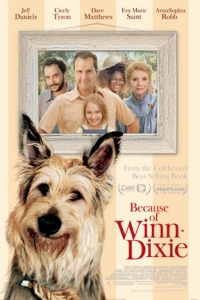 The best portrayal of a solid, faithful movie pastor that I have seen in recent years was Preacher from Because of Winn-Dixie. Played by Jeff Daniels, Preacher is a deep character with personal problems. He was abandoned by his wife because she no longer wanted to be married to a pastor, now he is lonely. He loves and wants to care for his little small-town flock. He has a sincere desire to find ways to make God’s Word meaningful to his congregation, and buries himself in his work. Because of this, he frequently lacks time for his daughter, but we can tell that he deeply loves her. He gets angry. He is unashamed to pray in public. In other words, he is human. He is flawed, but he is trying to do what is right. It is a shame that characters like Preacher, who accurately reflect many pastors, emerge so infrequently in film. But the fact is, most of the time, pastors simply don’t exist in the landscape of film. When these pastors do not appear where they should in the cultural landscape, it conveys the idea that they are irrelevant, inconsequential, or worse, completely absent from thought. The assumption is that pastors are unnecessary.
 At this junction of my life I feel like an average Joe. I frequently give advice to a group of misfits. I’m a funny guy who tends to take a laid-back approach to life. With that being said, I can relate to Peter LaFleur from Dodgeball: A True Underdog Story. Peter La Fleur, played by the excellent Vince Vaughn, operates a small gym called Average Joes. The opening scenes in Average Joes could have very well used the theme song from the television sitcom, Cheers, a place where everybody knows your name. Too bad Peter has been too busy developing genuine friendships to hone his business sense. Average Joes is in foreclosure unless they can come up with $50,000. To do this, these averages will have to become something extraordinary. And Peter La Fleur must step out in faith, and put everything of value to him on the line.
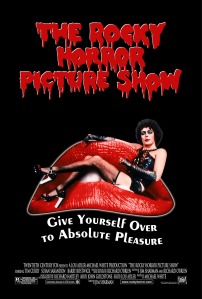 I was interested in this topic from the first time I read the challenge because of the way it is worded. It is asking for a movie that no one would expect you to love. This doesn’t imply that you actually do love that movie. It forces you to put yourself in the shoes of those that know you. You have to inspect your own preferences. If the challenge was asking for a film that you actually liked, then it would say, “A movie that people would be surprised to find that you loved.”
 I think it is a lot of fun, and the musical numbers will be stuck in your head for days. Tim Curry as the transvestite from the planet of Transylvania is funny, creepy, and campy all at once. This is my favorite movie to watch on Halloween.
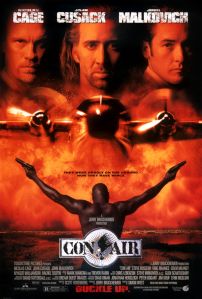 I have to say that 1997’s Jerry Bruckheimer produced Con Air is an extremely fun ride, and it is one of my favorite action films. If I see this one on TV I will almost always watch it. The film is so over-the-top with its characters, dialogue, and situations that it can’t be truly believable and I don’t think it is meant to be. I know that this is not a high quality film, it doesn’t answer any metaphysical questions. But it is a good popcorn movie and it is endlessly re-watchable, even 15 years after it was released. True to most Bruckheimer productions Con Air is loud, crazy, and completely mindless fun during its 123-minute running time.
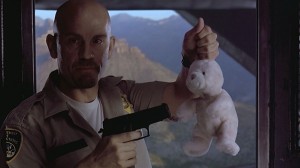 With a cast like that stuck on a plane together for at least half of the film, it has to be good.
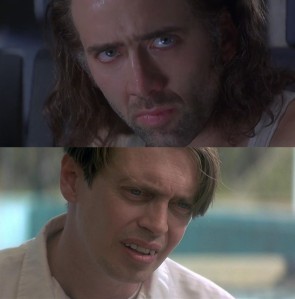 Con Air is one boldly energetic and exciting action flick. I’ve seen the movie well over a dozen times since it first came out in 1997 and it’s never lost its luster or ability to be exciting, brain-dead entertainment. It’s one wild ride that I am a bit ashamed to say that I love to take.
 I have two films that have changed my ideas about the food industry. It has made me question everything I put in my mouth. These are the Morgan Spurlock McDonald’s experiment, Super Size Me, and Food, Inc. that asks how much we really know about the food we buy in the supermarket. After watching both of these movies, I wanted to move to a big 40 acre farm in Montana where my family and I could grow crops and raise cattle and we could seclude ourselves. Of course, then I got hungry and couldn’t afford to be a vegan, so I settled for a double cheeseburger.
 This is an eye-opening and shocking look at the effects of fast food on the body, and it’s more important that ever with 60% of the United States being obese. We are literally eating ourselves to death.
 A little over halfway through the month, the doctors finally catch on to the danger and indicate that the side effects are going far beyond what they predicted. His triglycerides and cholesterol are up, but his liver also looks like he has been a heavy drinker all his life. By the end of the 30 days, he’s put on almost 25 lbs, and his body fat has increased from 10% to 18%. In the closing credits, we’re told that it took him 8 weeks to get his liver back to normal and over one year to get down to his previous weight.
 I consider myself pretty well educated when it comes to nutrition. I mean, I actually read and understand most of the stuff that is put on the nutrition labels. But I was shocked when I watched Food, Inc. and found out that some of those items that I thought were healthy could have been doctored to the point that they harbor franken-bacteria. And if I was this taken aback, I can imagine how many people who don’t take the time to educate themselves would really be stunned if they realized where their food comes from and what the food they are consuming could be doing to their bodies. Most Americans biggest concern about their food is that it is fast, cheap, and tasty. Food, Inc. examines the costs of valuing cost and convenience over nutrition and environmental impact.
 This was another category that suffered from the use of vague language. What is a classic movie? What criteria would you use to define a classic? I think what determines a classic film is the same thing that determines a classic piece of literature: the test of time. No film or literature of substandard quality will survive that test. The key to passing this test of time is a work’s universal appeal. This asks for my favorite, not the most classic, so I am pleased to share my favorite classic movie, North By Northwest.
 The 1950s were a great decade for Alfred Hitchcock. He had so many hits with Strangers on a Train, Dial M for Murder, Rear Window, To Catch a Thief, and The Man Who Knew Too Much. He also had a TV show, Alfred Hitchcock Presents. But in 1958, Vertigo was released and failed to impress critics or audiences. Hitchcock was undoubtedly disappointed by this and couldn’t know that Vertigo would eventually be considered one of his masterpieces. But he vowed that his next project would be a more tested and tried effort that would be more of a crowd-pleaser. The film was a box-office hit, second only to Ben-Hur for the year, and got positive reviews from critics.
 It starred Cary Grant as Roger Thornhill a New York advertising executive who is mistakenly identified as a secret government agent, this put a target on his back. Then he’s framed for murder, this puts him on the run from the police as well as the bad guys. While on the run, he meets Eve Kendall (Eva Marie Saint), who apparently believes his story and wants to help. I’m not going to give you any more about the plot because I want everyone to see it. It has so many iconic scenes and it is still powerful today. It influenced a whole genre of action-suspense-espionage movies. Only three years after its release, the first James Bond film, Dr. No, appeared. Of course, James Bond is a spy, whereas Roger Thornhill was only mistaken for one. But both films have implausible action sequences in outrageous locations like Mount Rushmore. They both have beautiful but mysterious women who take an interest in the hero. And both have a well-dressed leading man who is suave, has a knack for one-liners, a fondness for liquor. You can probably think of dozens of movies since 1959 that have operated on those same principles.
 With North by Northwest, Hitchcock tweaked the basic man-on-the-run story with witty dialogue, charismatic performances, and visually arresting action sequences. He demonstrated that these elements of basic popular entertainment, which are sadly looked down upon by some who call themselves critics, could be applied to big-budget studio films. He showed that a movie could be entertaining, thrilling, and funny, smart and well-produced. It didn’t have to choose to be either high-brow or low-brow. North By Northwest is an extremely entertaining thrill ride. There is not a lot of substance or meaning to it, it is just a tremendously fun roller coaster ride that Hitchcock takes us on. When I first saw it as a kid, I was hooked. And it set a precedent for hundreds of blockbusters that followed in its wake.
  Growing up, I remember getting to go to work with my dad from time to time. My dad has worked for several different companies, from pest control to shoe repair, but I will never forget the day that he took me to work with him at the radio station. He sold airtime to businesses that wanted to advertise on the station. I got to sit in the booth with the Djs, I even recorded a little radio spot when I was probably no older than 4 or 5 for the station that used to be GC-101.
 This one was a fairly easy choice. I don’t tend to re-watch many movies, only those that I really enjoy. But I remember seeing Braveheart in theaters three times when I was only 12. That means that begged my parents or friends parents to take me because I was too young to go by myself. This was the first DVD I ever bought. I watched it so many times in High School that I now have the movie memorized. I’m not sure of my heritage, I’ve never done the ancestral digging to find out where my origins truly lie, but because of this movie, I tell people I’m Scottish. And I am proud to be a Scotsman.
 It probably had something to do with the gory violence, and the comedic writing probably helped as well. But what really got me, I think, was the fact that I was able to lose myself in the film and become William, joining him on his journey.
 Looking back, it has been a while since I sat down and critically watched this film. It does suffer a bit from it’s length as it tends to drag a bit in the 2nd and 4th acts. That would be the background story of Robert the Bruce (little known fact: the title Braveheart was historically attributed to him, not Wallace.), and the love affair with the princess, which is total historical rubbish (she would have been in France at the time and only about 13 years old) and completely unnecessary, and contrary, to the heart of the film. That being said, this is still a film which I plan on showing to my sons and daughter when they are on the brink of the teenage wasteland. I hope that it can teach them what it taught me. That a life that is lived without purpose is not lived at all.