
Just after he eloquently summed up God’s perfect law with the words, “You shall love the Lord your God with all your heart and with all your soul and with all your strength and with all your mind, and your neighbor as yourself.” (Luke 10:27) This expert on the Jewish law challenged Jesus by asking, “Who is my neighbor?” (Luke 10:29) Jesus responded, as he often did, by telling a story.
The story he told was surprising to everyone who heard it. It was the tale of a man who had fallen on some particularly hard times and had been beaten, robbed, and left for dead on the side of the road. Who would be a neighbor to this poor helpless man? Perhaps a teacher of the law? No, he was far too busy and continued on his way. Maybe a Priest? No, he was worried that the man might make him unclean. But then along came a Samaritan.
Now, the Jews considered Samaritans to be half-breeds, products of the immoral intermarrying and religious blending that took place hundreds of years before during the Babylonian exile. For a Samaritan to even be mentioned in the same story as these well-respected religious professionals was shocking, but that he would be the hero was almost intolerable.
But that was Jesus’ point as he described the compassion which the Samaritan traveler had on the victim of this crime. He went out of his way to help him and bandage his wounds, he sat him on his animal and walked alongside until they came to a hospital, and even beyond that he took care of his bills and made a plan to return to ensure that he was well treated. At this point, the lawyer must have been seething at Jesus’ words, but he was trapped as Jesus asked, “Which of these three, do you think, proved to be a neighbor to the man who fell among the robbers?” He said, “The one who showed him mercy.” And Jesus said to him, “You go, and do likewise.” (Luke 10:36-37)
Won’t You Be My Neighbor
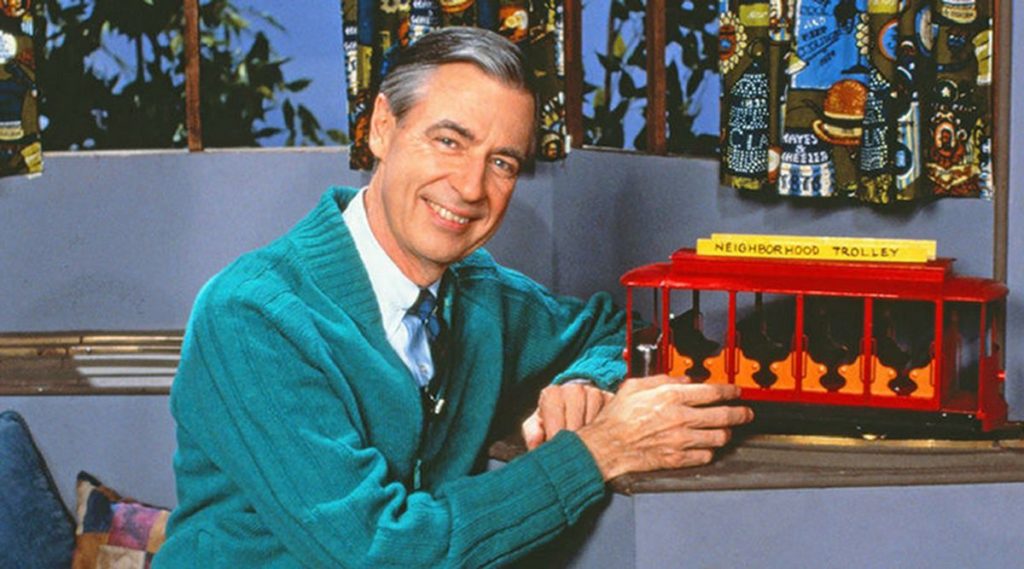
As the camera pans over the familiar model town, the yellow caution light flashes, and the piano notes sound, an inviting face opens the door to ask us, “Please, won’t you be my neighbor?” By performing this liturgy at the beginning of each of his 912 episodes, Mister Rogers was submitting to Jesus’ command to go and do likewise as he sought to be a neighbor to anyone who was hurting and confused. However, the invitation was also a confession that he needed a neighbor as well.
Fred Rogers did not see himself as a saint or a hero. He simply stood on his doorstep and offered the same unconditional love and grace to others that he knew he needed every day to survive. Mister Rogers was an ordained Presbyterian minister and he knew better than most that each breath that we take is evidence of God’s amazing grace.
Won’t You Be My Neighbor was easily the best documentary film of 2018 because Morgan Neville captured the essence of Fred Rogers’ mission to speak directly to the children of an entire generation and to help them cope with the fact that the world is a dark and scary place. He didn’t try to fool kids or entertain them. He leaned in to teach them, in a way that we are sorely lacking today, that things like death, divorce, and disaster happen and we can’t control them. But we can manage our feelings in healthy ways and talk about them.
I think we are experiencing this Rogers renaissance because we are lacking a voice that will speak to our children, and us as adults, to provide guidance through difficult and confusing times. And Fred Rogers would not want us to idolize him in this manner. Rather, he would challenge us to take up Jesus’ command to be neighbors to one another. After all, it’s hard to hate someone you just begged in song to be your neighbor.
A Beautiful Day in the Neighborhood
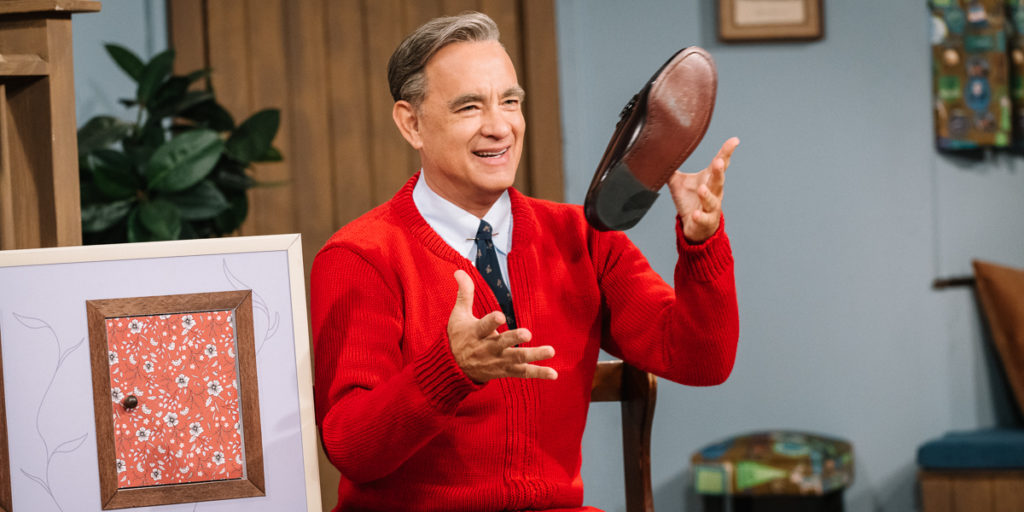
The new film, A Beautiful Day in the Neighborhood, directed by Marielle Heller, features Tom Hanks playing the iconic role of Mister Rogers. However, this is not another documentary. Instead, it places Hanks across from Matthew Rhys in the role of investigative reporter Lloyd Vogel. This character is a mixture of fiction and fact as the whole film is based on an Esquire article by journalist Tom Junod entitled, “Can You Say… Hero?” (beware of some adult language). However, it takes a good bit of liberty with the establishing storyline, creating a strained relationship between a father (Chris Cooper) and son, to build the stakes.
In the end, the film is really about this fictional Vogel family and Fred Rogers is a high profile side character who steps in and provides an open ear and an open heart. It is a very good story overall and I was moved several times through Hanks’ performance, but my major difficulty with A Beautiful Day in the Neighborhood is that it removes any mention of Jesus or really any religious teaching. This is somewhat understandable because it is told much like one of Mister Rogers’ episodes and he avoided spiritual talk on the air.
Unfortunately, if you remove Mister Rogers’ foundation of faith, it turns his desire to care for people and heal relationships into secular humanism at its best and it gives no foundation for the beautiful mission of his life. A lack of a foundation leads people to all kinds of wild and fanciful speculations about what skeletons he hid in his closet. Whether it be the oft mentioned Navy SEAL service or sleeves of tattoos hidden under those zippered cardigan sweaters.
What Would Mister Rogers Say Today?
In the midst of a presidential inquisition and constant bickering on Capitol Hill, I wonder what sage advice Fred Rogers would have. Providentially, Tom Junod shared an email that came from his lifelong correspondence in a recent article for the Atlantic explaining his involvement with the film and his relationship with Rogers. The subject of the email was what Rogers would say to the then-current impeachment hearings of Bill Clinton.
Last week I woke up thinking how I would like to go on the air and say something like “Whoever is without sin cast the first stone” or “The Lord’s property is always to have mercy” or some other outlandish thing, and then ask for a minute of silence to think about forgiveness for those who want it. In fact if our country could dwell on forgiveness for a while I think that would be the one real positive outcome of the pain which must be pervasive in the White House and beyond. I’ve already written letters to both the Clintons and the Gores saying that often “enormous growth comes out of enormous pain.” I trust that will be so for all of us. The attitude which makes me (sometimes physically) sick is the “holier than thou” one.
As always, Mister Rogers’ words are timeless because they don’t speak to the issues but to the underlying emotions and situation deep within the human heart. His answers are profound because they sound hauntingly like the words of Jesus who would remind us that to seek God’s kingdom means to love God first and to love our neighbor (even the one we don’t really like) from the overflow and to work for their good.




 Growing up, I remember getting to go to work with my dad from time to time. My dad has worked for several different companies, from pest control to shoe repair, but I will never forget the day that he took me to work with him at the radio station. He sold airtime to businesses that wanted to advertise on the station. I got to sit in the booth with the Djs, I even recorded a little radio spot when I was probably no older than 4 or 5 for the station that used to be GC-101.
 I don’t watch movies that make me sad. The reason most people watch movies is to escape for a couple of hours from your life. Who wants to escape to a sad alternate reality? On the other hand, there are plenty of movies with sad elements or scenes that make me cry no matter how many times I watch them. Yeah, that’s right I cry at movies. But that sadness is usually part of an ultimate happy ending or uplifting message.
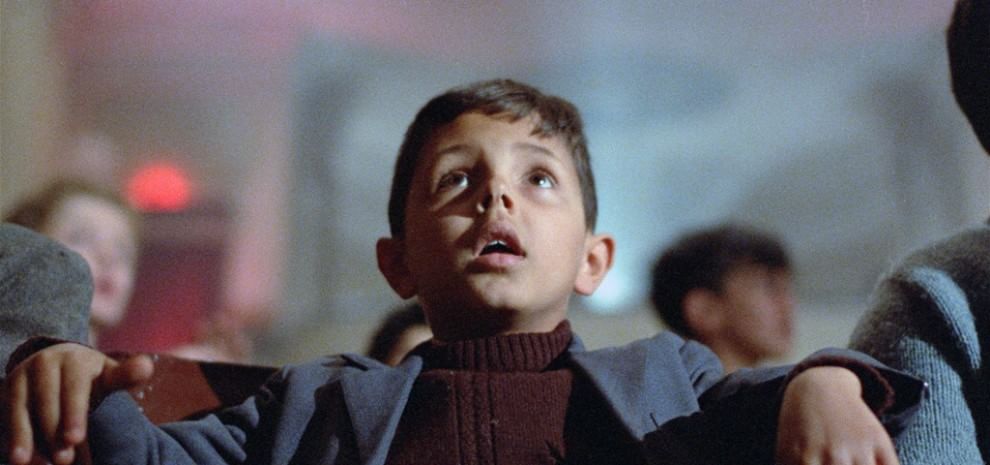
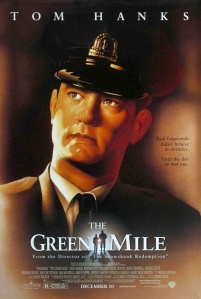 To narrow it down, I thought of 5 sad movies that I had seen. Those 5 were: My Girl, Boy with the Striped Pajamas, Dead Poets Society, A Walk To Remember, and The Green Mile. The saddest movie that I could think of was The Green Mile. At John Coffey’s execution everyone is weeping at seeing something so unjust. Everything from the scene where Paul goes into John’s cell and asks him what he wants him to do is sad. He can’t bear the thought of killing “one of God’s true miracles.” He doesn’t want to stand before God at the judgment and have to answer for why he killed an innocent man. Then as John asks to see a movie, he sits amazed at the beauty that he is beholding. At the execution I have to stop myself from sobbing out loud. Even the ending when we see Paul as an old man grieving over the loss of a friend saying that this is his punishment killing John Coffey. For those that think Stephen King is only a horror author, this film is the answer to that.
 So when the folks at Pixar brought the script and some storyboards for what would eventually become Toy Story 2 to Disney, they made the smart decision to pour their resources into this sequel. Most sequels simply dilute the story and characters like too much water added to good Scotch. But not all sequels are bad. The best sequels take the original film at face value and then seamlessly expand from there with a movie that stands on it’s own merit instead of being propped up simply by the success of it’s predecessor. For instance, I loved Terminator II: Judgment Day from the moment I first watched it, but it took me several years to build up a desire to watch the original Terminator.
 My kids love it because even though it is now over 10 years old it looks great with an attention to detail that Pixar has become known for. The colors and textures are light years (no pun intended) better than the original, and that’s saying something because it was beautiful and the improvement came in just 4 year’s time. Also, my kids are continuously quoting lines from these movies, and I believe it’s because the movie isn’t pandering and condescending to “their level.” The dialogue is incredible for a kids movie and it is carried by a voice cast that has expanded its diversity to include Joan Cusack. But my kids watch it over and over and hear different things every time. The story is easy enough to understand that you could follow it even if the sound on your TV went out, but everything about the story is enhanced because of the humorous and touching script.
 When my kids watched The Empire Strikes Back for the first time and Vader spills his big secret, one of my kids said it’s just like Toy Story. Speaking of twists, though I can’t remember the first time I watched this film, I am willing to bet that I was surprised at the devious selfishness of Stinky Pete. And even though we are used to movies like this now, this one is simply action packed, with at least 5 distinct chase scenes, two shootouts, several covert operations, and epic surroundings for all of the above make this movie one that I find it hard to rip myself away from.
 It would have been impossible had Pixar not broken ground in Toy Story 2 with the chase through the airport baggage area. Also, think of as many animated films as you can that have made you want to both laugh and cry, applaud and think, remember and wonder. I would be willing to wager that almost all of those films are from the storytelling magicians at Pixar. They just have the ability and lack of inhibition that lets them expertly dive into issues that most animated or childrens’ films won’t touch. Issues like loss, rejection, abandonment, fear, identity, purpose, and love.
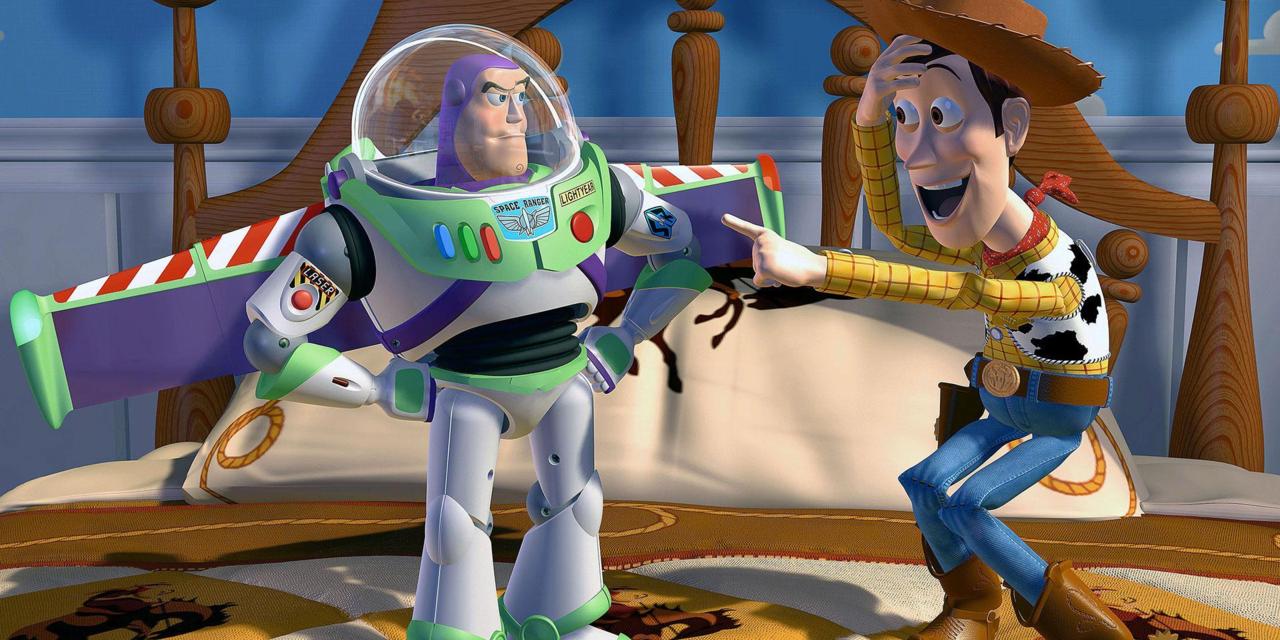
 Who knew that a simple movie about the secret lives of toys could go so deep as to teach its viewers something profound about themselves. That is the art of film-making, the magic of Pixar, and the reason why I can’t stop watching movies. Because movies have this ability in common with Scripture. I love Scripture because it can destroy me one minute as it reveals my sin, then restore me as it reveals my Savior. And I keep watching movies because I hope that the next one will cut me open to my core and teach me a little bit more about myself. If my kids watch the Toy Story movies and want to act like Woody or Buzz, that is fine with me, because both characters exemplify the type of behavior and strength and purity of character that I wish everyone had and pray that my children will develop. I can’t say that about every cartoon character. The thing that makes Toy Story great is the desire it creates in its viewers to not only observe greatness but to pursue and attain it.