At this point, the story of Quentin Tarantino has become fodder of the dreams of independent and amatuer filmmakers. Just over 20 years ago, Tarantino was working at a video store and all he had were his dreams. Now he is considered to be one of the most creative and visionary storytellers of our generation. His name has been listed along those of Scorsese, Kubrick, and Hitchcock. This is the film that started all of that. Before Pulp Fiction rocketed him to fame, Reservoir Dogs shocked and surprised audiences and critics alike. Empire magazine called it the greatest independent film of all time. It cost 1.2 million to make and doubled that in box office reciepts even though it was shown in less than 100 theaters. Tarantino has cited Stanley Kubrick’s The Killing as one of the major influences for Reservoir Dogs. Sadly, I have not seen this earlier gem. But I see many similarities between Kubrick and Tarantino. Tarantino, the fast-talking former video store clerk remains a major player. In fact, of his seven features, five are listed in the IMDb Top 250:
- Reservoir Dogs
- Jackie Brown
- Kill Bill
- Inglourious Basterds
- Django Unchained
So, what can I say about Reservoir Dogs that hasn’t already been said? Not much, but I can say it again. It’s a straightforward heist film that follows the genre’s basic format. A group of talented professionals band together for one big score. The attempt goes awry and the members turn on each other in the aftermath. There’s also a traitor, often an undercover cop, who places the others in jeopardy, willingly or not. In his debut film, Tarantino takes this model and infuses it with his now signature style and breathes life and chaos into the predictable formula.
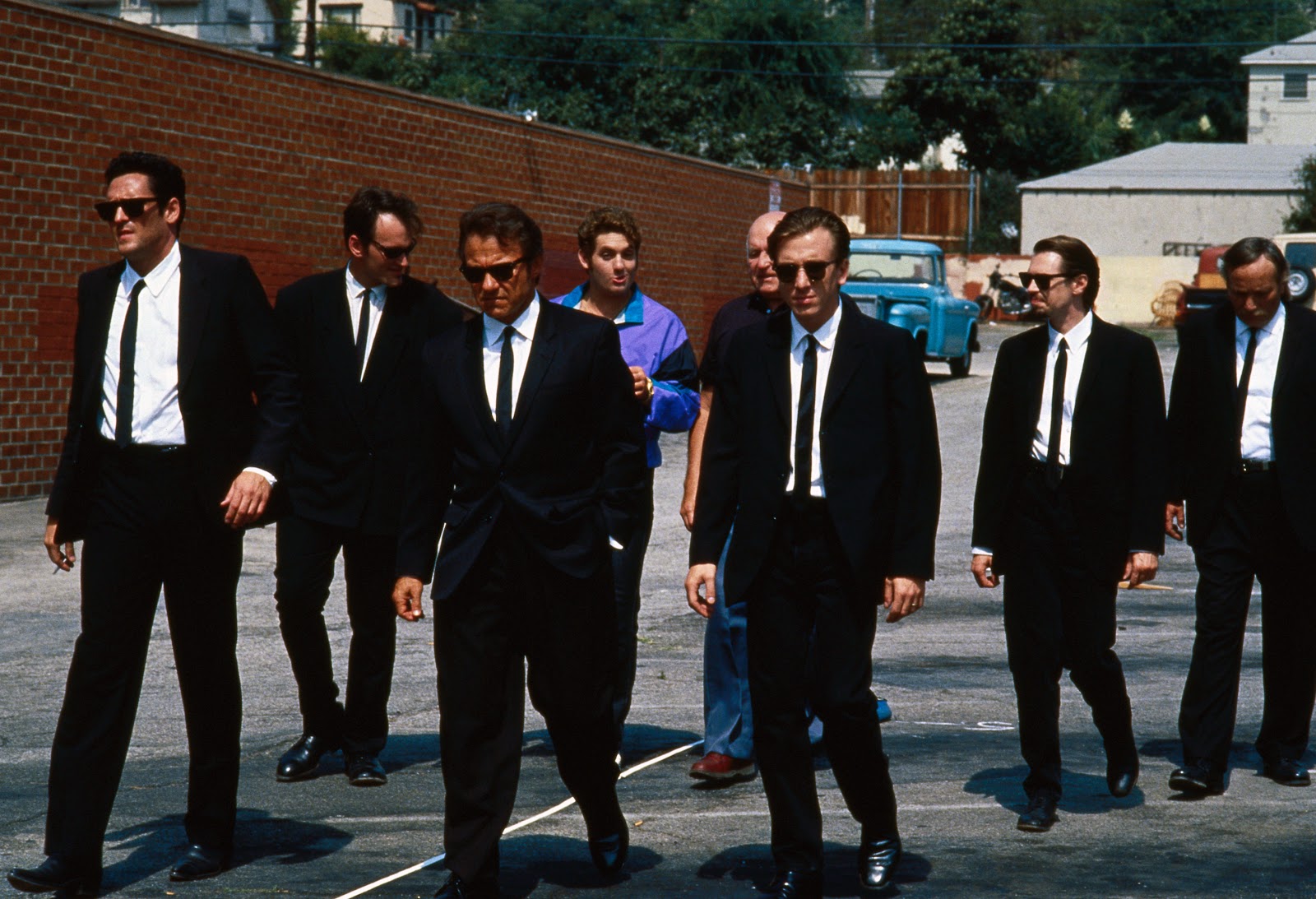
First of all, Tarantino injects on the genre is his over-the-top dialogue, which has become more renowned because of Pulp Fiction, Jackie Brown, and his more recent projects. Reservoir Dogs opens with a lengthy conversation about the meaning of Madonna’s “Like a Virgin”, led by Tarantino himself as Mr. Brown. This type of pop-culture discussion from his characters would become a signature part of Tarantino’s movies going forward. Heist films aren’t generally known for their dialogue, so this was quite a dramatic change and widely expanded the audience for this movie. Characters mention Lee Marvin, Marlon Brando, the Thing from the Fantastic Four, The Lost Boys, and other enjoyable references. These guys may be involved in a daring crime, but they’re still people with other interests.
Secondly, Tarantino removes the normal focus of a heist film. The only scene we get of the heist is Mr. Pink (Steve Buscemi) fleeing from police after being ambushed. He recounts his escape to Mr. White (Harvey Keitel) after they gather at a vacant warehouse, which is the primary setting for the movie. By doing this, he deepens the film. The film really begins in the aftermath of the botched heist, and it’s jarring to leap right into the unknown situation. Mr. White is driving a getaway car while his cohort Mr. Orange (Tim Roth) writhes in the back seat and bleeds profusely from a gut shot. Most heist films introduce us to the characters and focus on their preparations for the big robbery. Tarantino does flash back to the time prior to the heist, but he’s not interested in their specific plans. Instead, he’s concerned with briefly setting up these professional thieves and their backgrounds.

Third, heist movies typically focus on criminals, there usually is a lead character (or a group of characters) that we identify with and want to succeed. A good example is Frank Ocean, who we follow from the start of Oceans 11, and while we meet others, we are tied to Frank and root for him and his team, even though he is a crook. In Reservoir Dogs, it’s not clear who we should root for because Tarantino scrambles the narrative. If the story was told chronologically, we’d likely connect with Tim Roth’s undercover cop, known by the alias Mr. Orange. In this structure, however, we don’t learn his identity and back story until more than an hour into the movie. By that point, we’ve grown to like Harvey Keitel’s Mr. White, especially because of his loyalty to his comrade. Steve Buscemi’s Mr. Pink is also interesting, though he’s a bit too manic and doesn’t tip. After we see the lengthy interlude of Orange’s preparations to infiltrate the gang, we feel sorry for the guy, but he’s not really our hero. Tarantino is taking a real chance by stopping the forward plot so late in the game. Watching Orange rehearse his made-up story is a classic segment, but it only works if we’re invested in the story. Tarantino trusts that we’re interested enough in this world to stick with him until the final shootout.

A fourth departure is the graphic violence, which keeps us on edge throughout the movie. Unlike gangster films, heist movies usually spend more time on the characters and plans of the heist and don’t include brutal killings. Tarantino actually moves some of the grisliest moments off-screen, but the overall nastiness remains. The prime example is Mr. Blond (Michael Madsen), who’s recently spent time in prison and has returned with a crazy streak. In the movie’s signature scene, he tortures a helpless cop, cuts off his ear, and prepares to burn him with gasoline. There’s no motive for this action beyond inflicting pain in the most vicious way possible. Strutting to the sweet sounds of “Stuck in the Middle with You” by Stealers Wheel, he delivers a frightening, yet cool depiction of a psychopath. This is not your everyday working-class thief.
The ending of the film is classic. It encapsulates the nihilism that we have seen throughout. We see loyalty and trust as well as betrayal and death. So, should everyone watch this film? Certainly not. If coarse language and violence is offensive to you, if you’ve seen other Tarantino films and been disgusted, then this won’t be for you. However, if you are a fan of gangster and heist movies or if you enjoy Tarantino’s style, you will like this first of his efforts. Tarantino injects his own unconventional style into the genre and delivers a powerful, energetic, and original film.
Do you agree with me? Am I way off on this one? Let me know in the comments below or on Twitter or Facebook.


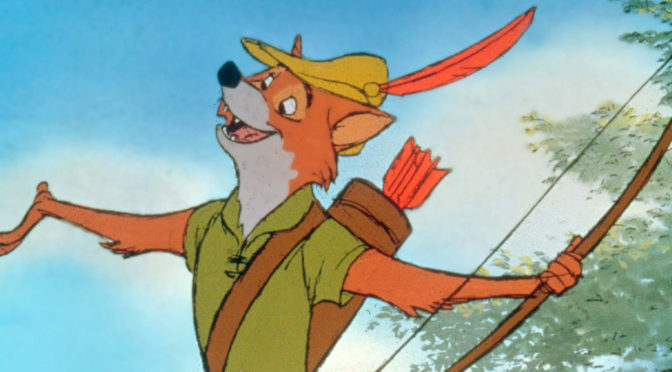
 Looking back, as an adult and a film snob, I can see that the picture is notorious for its corner-cutting animation, it simply doesn’t have the sparkling hand-drawn detail of earlier Disney masterpieces, or the glitzy sheen of the latter ones. It’s certainly one of the more crudely-drawn productions of the company. But even when you stack up the complaints lobbed at this incarnation of the Robin Hood tale, they really don’t matter, because in the end we get a richly entertaining good time, and I’m glad to say that this film is just as captivating to my children as it was to me.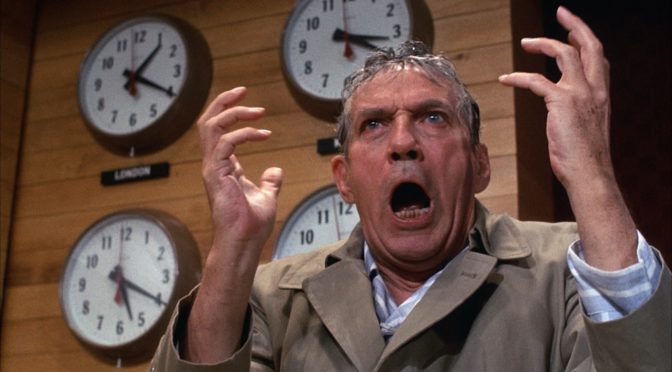
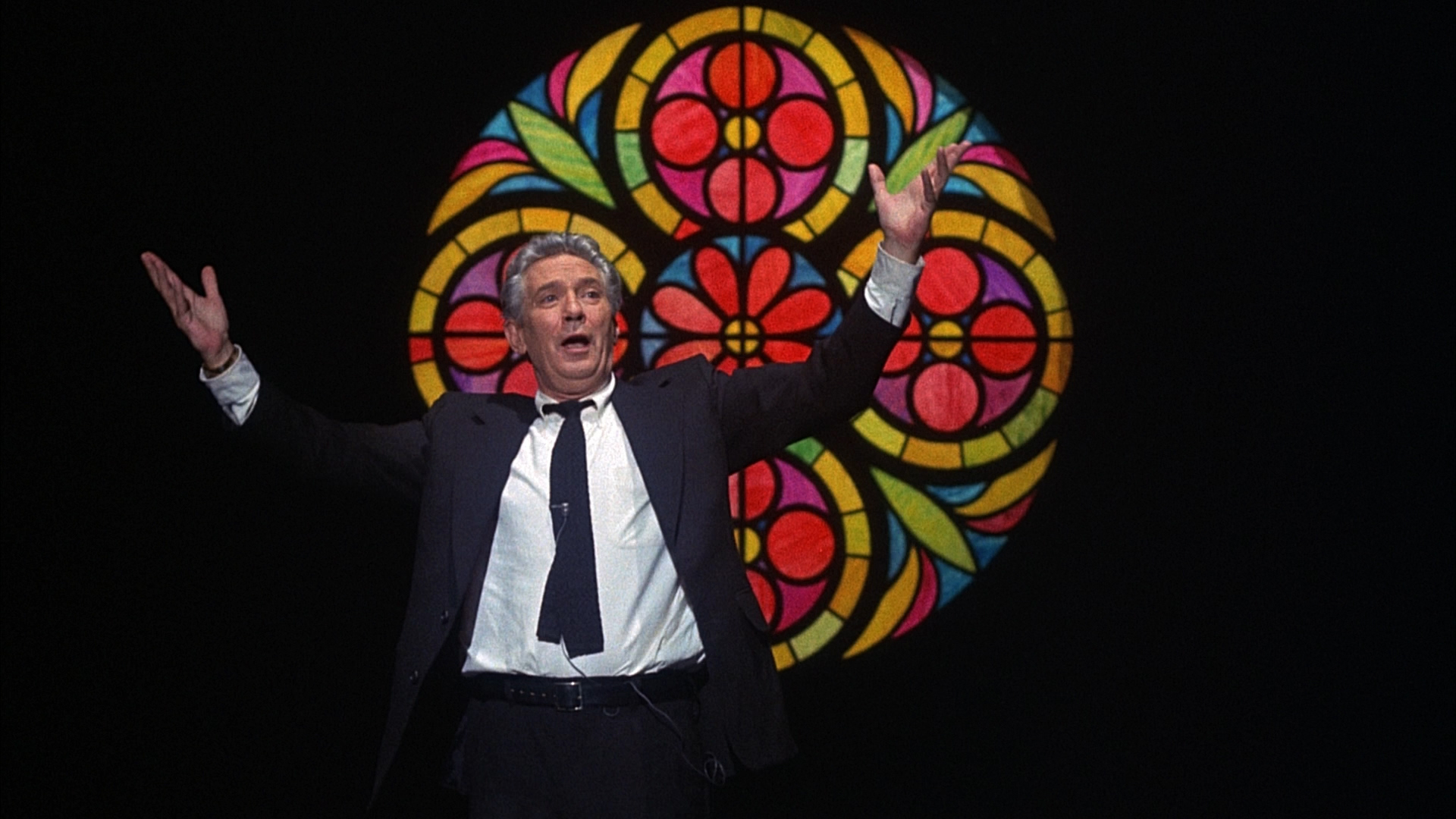
 Frank Hackett’s (Robert Duvall) character is also the future of television. He could not care less about the news division or even the quality of the network for that matter. He is a CCA (The Communication Corporation of America) man. This is the company that has purchased UBS and as far as Hackett is concerned UBS exists to serve the interests of CCA and it’s shareholders. And to that end he approves of Diana’s programming schemes once he sees the ratings skyrocket. Mind you, this film was made in 1976, years before all the cable “news” networks even existed and way before we had people willing to give up their privacy and what little dignity they have left on national television just to be recognized and become reality show “celebrities”.


 I didn’t expect a period price about 1970s TV news anchors to be funny. I remember seeing the previews back when Austin Powers was in his heyday thinking, “This is a cheap knockoff. Somebody trying to make money by getting in on a popular idea.” I didn’t even see Anchorman: The Legend of Ron Burgundy until relatively recently. But it immediately became one of my favorite and most quoted movies. It’s impossible not to laugh at this massive skit that is a perfect blend of left-field jokes and uncomfortable sexist humor. I was certainly not a Will Ferrell from the comedies he produced before Anchorman. I was so unimpressed by the Saturday Night Live skit based films that he did, like Night at the Roxbury, that Old School, Elf, and this film all flew under my radar. It wasn’t until I saw Stranger Than Fiction that Will Ferrell really got my attention and I began to look back through his filmography. And found that he has remarkable comedic timing and a way of fluctuating between over the top and deadpan deliveries that really translates well to the screen.
 But his crowning achievement is the creation of this fictional San Diego legend. You see, in the Seventies, men read the news. And the movie tells us that in San Diego, no one read it better than Ron Burgundy. In fact, he reads so well off the teleprompter that he’ll read anything (and I mean that). Burgundy rules the local news arena with the help of his crack news team. All men of course, but when the network forces the station manager (Fred Willard) to hire a female reporter, the sexy Veronica Corningstone (Christina Applegate), the men fall into a panic. And the world that they have come to know and love will never be the same.
 Anchorman is a wealth of wickedly stupid humor, the type that’s so dumb it could only ever be thought up by someone intimidatingly smart. That smart duet is Ferrell himself with his co-writer/director Adam McKay, who has teamed up with Ferrell three times since (Talladega Nights, Step Brothers, and The Other Guys). Ron Burgundy is hopelessly juvenile, terminally inappropriate, and so completely unpredictable that he’s also ridiculously funny. I will wager that this is the only film in which you will find someone shooting flames from the end of a jazz flute. But Anchorman is always willing to take things a few steps farther than you’d expect. The result is comedy which produces unstoppable belly laughs simply from the shock of where Ferrell takes the joke next.
 Possibly even more hilarious than Ferrell is his capable news crew. Steve Carrell as Brick Tamland repeatedly doubles me over with insane comments that seem to just come from out of the blue. He shouts, “LOUD NOISES!” when everyone else is in the station manager's office complaining about the addition of Corningstone to the news team. Paul Rudd’s reporter on the scene Brian Fantana is worth seeing just for his musk collection. Even Christina Applegate gets in a few good shots, because she is willing to dish out just as much as her fellow cast mates can throw at her. David Koechner is the weak point as the cowboy hat wearing sportscaster Champ Kind as he just made me uncomfortable. My biggest wish for this film would have been to see John C. Reilly in that spot.
 I get the feeling that half of this script was improvised on the spot, and that isn’t a bad thing. I wonder if once they got rolling on set, they just couldn’t stop. The talent pool on this cast was so deep, I can totally believe that at some point they simply abandoned the printed page after realizing they were coming up with better stuff just giving each other the giggles. And with cameos from people like Tim Robbins, Luke Wilson, Ben Stiller, Jack Black, and Vince Vaughn the comedy chemistry and laugh factor is wrenched up even higher.
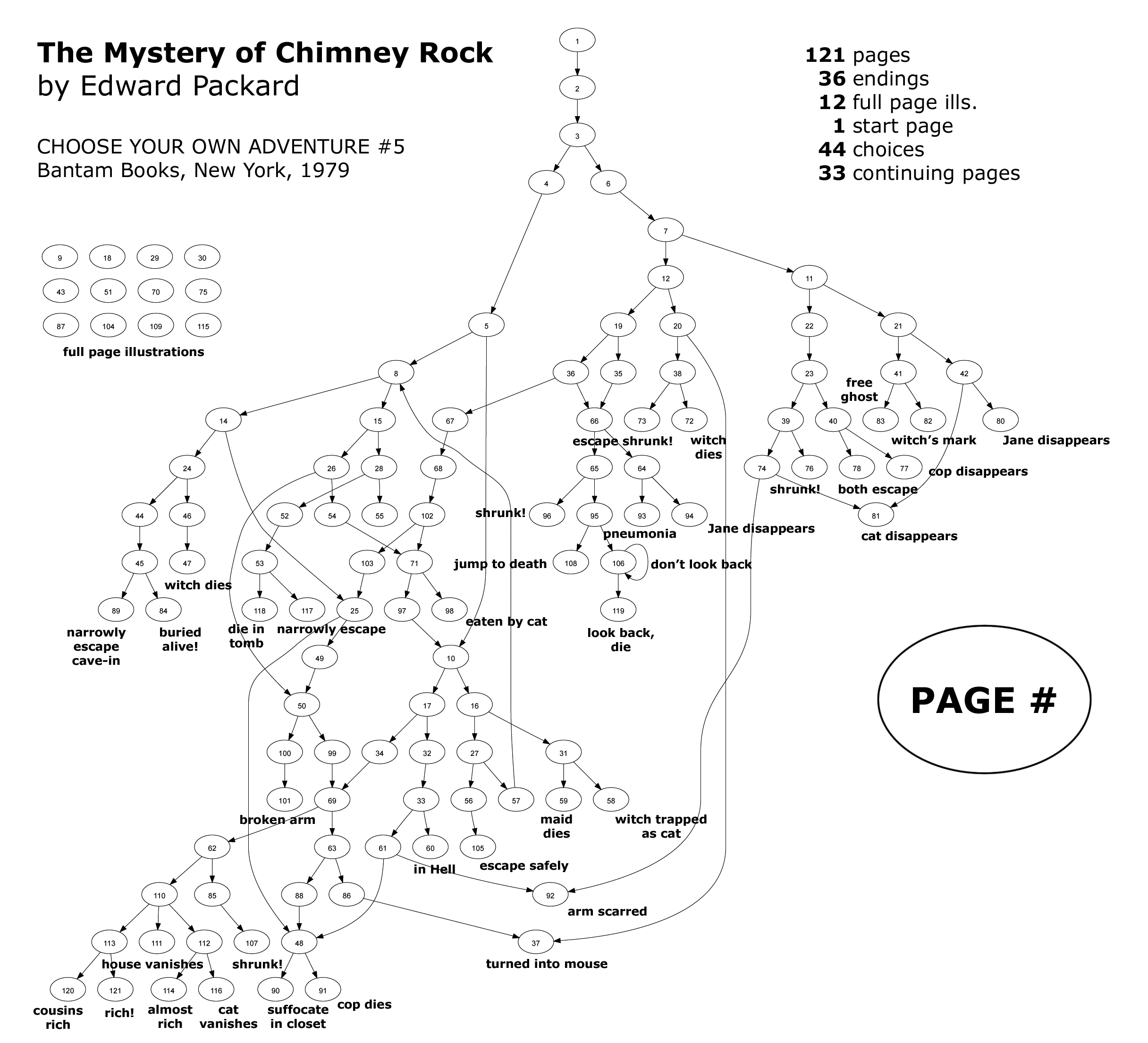
 I’m a little wary of this question. It seems like the person that started this challenge may be sitting in an office in Hollywood waiting for all of us film geeks to get to day 24. Then when we post our great ideas he steals the ideas for his own and presents them to his boss. Perhaps I’m just paranoid, but I’m not sure if I want to put my great idea on the internet for everyone to see. Perhaps if I post it here with a time-stamp and a copyright at the bottom of the page that will be sufficient to prove that it was my idea before any one else. Well, I’ll live on the edge and throw caution to the wind and tell you all, but you have to promise to at least give me free screenings to your movies that will make millions after you steal my idea. It really is a simple concept and all the technology to make it happen already exists. In a sentence, I’m talking about audience interactive plot control or Choose Your Own Adventure.