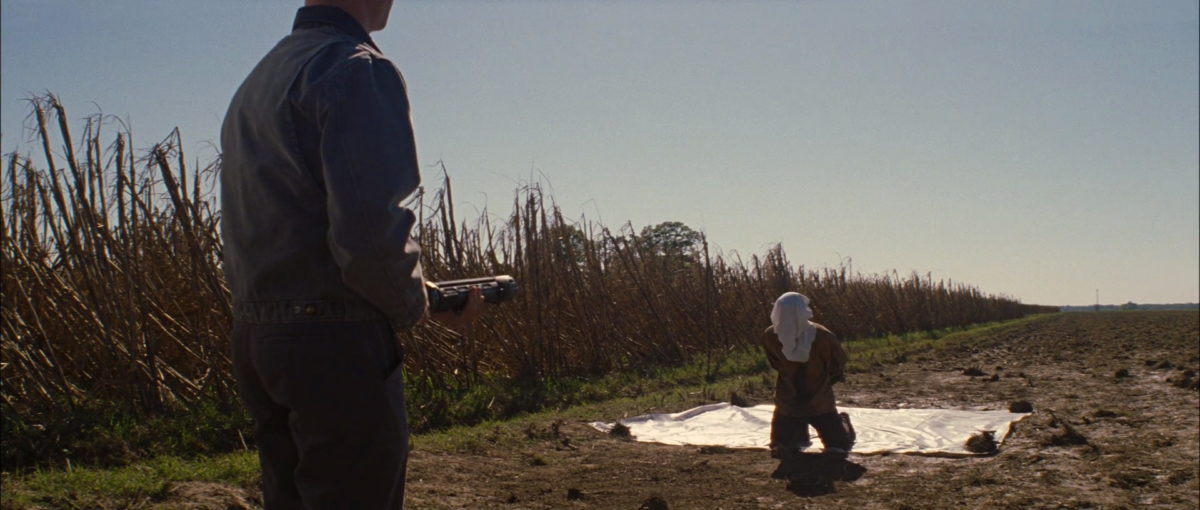
Director Rian Johnson began his career with the language-muddling high school film noir Brick, before moving on to the con-man film The Brothers Bloom, yet his third film, arguably his best, is a science fiction time-travel action film called Looper. Creating an original, but familiar location of near-future Earth, Johnson is able to place interesting characters with a complex time travel story line and let the audience go along for the ride.
Roger Ebert’s original review from 2012.
In the year 2044 time travel has not yet been invented, but thirty years later it will have been. Joe (Joseph Gordon-Levitt) is a Looper, a man hired to assassinate troublesome enemies of criminal gangs in 2074. These men are transported back in time with silver attached to their backs, are killed by the loopers and disposed of. 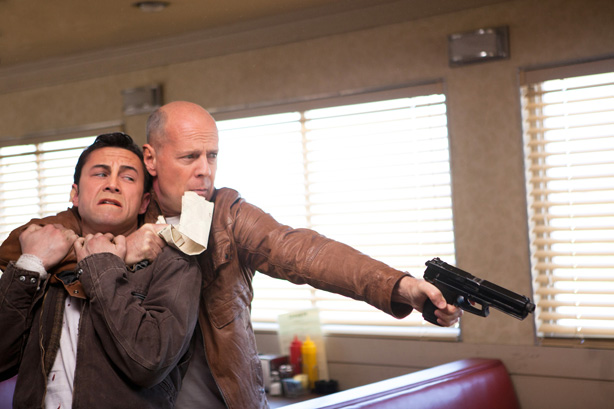 While it is a lucrative career, there is one downside, Loopers are expected to ‘close the loop’ by assassinating themselves. At this point they are given a huge payout and are effectively retired, left to enjoy the remaining 30 years of their life. When Joe’s future self (Bruce Willis) appears before young Joe, he hesitates to kill him, allowing him to escape and forces the younger self to track down the older self and kill him before the leader of the loopers, Abe (Jeff Daniels) finds him. The chase leads the two men to a remote farm, the home to Sara (Emily Blunt) and her son Cid (Pierce Gagnon), where they must finally sort out the ever-growing list of potential paradoxes.
Looper as a science fiction film is innovative but thoughtful. There are nods to previous classics in the genre, and while many have compared it to The Matrix, it is actually more akin to The Terminator. There is time travel, a seemingly convoluted plot to assassinate and defend and a potentially unstoppable killer at its core. Yet Willis/Gordon-Levitt are a better pair than Schwarzenegger/Biehn and the plot allows for a neat summary at the end, to avoid any potential sequel issues. It’s nice for a modern film not to immediately play for a sequel with a cliffhanger ending and Johnson’s script is almost wipe-clean in its conclusion.
 The cast are uniformly excellent and Emily Blunt and Joseph Gordon-Levitt (with a prosthetic nose which is very convincing in the close-up shots) are as good as you would imagine. It is however, Bruce Willis who is the stand-out. It’s been a long time since Willis has had to show any range, and while he gets to show-off his action chops in a series of scenes that will delight fans of Die Hard, it is in the more emotional scenes that he excels. In fact after the barmy opening act, Looper is strongest when engaging in the depth of character on display.
Looper doesn’t just rest on engaging characters and dialogue though and the action scenes walk the line between slick and cool gun fights and visceral horror gore and violence. In an early scene when another old looper avoids execution, the methods used to bring him to ‘justice’ are horrific and more at home in a slasher horror. It is this edge-of-your-seat, adrenaline-fueled mayhem that gives Looper it’s edge and allows the character development to ground it, while simultaneously allowing the plot not to stall. It’s a masterful balancing act by Johnson and his team.
 Looper is an exciting, original-yet-familiar science fiction action film that is likely to become more and more popular with age. The term ‘Cult Classic’ is often applied to low-budget films that were passed by on their original runs, but Looper has all the hallmarks of a film that will transcend this status and become a sleeper classic. While a lot of science fiction films are all flashy effects and no soul, Looper bucks the trend and delivers something slick, but with a heart of emotion. Just don’t ask about the time travel paradoxes or you’ll be stuck in a diner for hours, making charts out of straws.




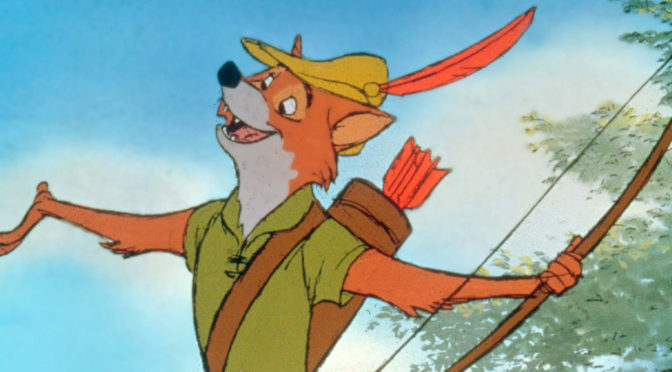
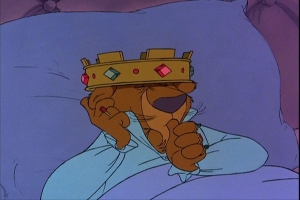 Looking back, as an adult and a film snob, I can see that the picture is notorious for its corner-cutting animation, it simply doesn’t have the sparkling hand-drawn detail of earlier Disney masterpieces, or the glitzy sheen of the latter ones. It’s certainly one of the more crudely-drawn productions of the company. But even when you stack up the complaints lobbed at this incarnation of the Robin Hood tale, they really don’t matter, because in the end we get a richly entertaining good time, and I’m glad to say that this film is just as captivating to my children as it was to me.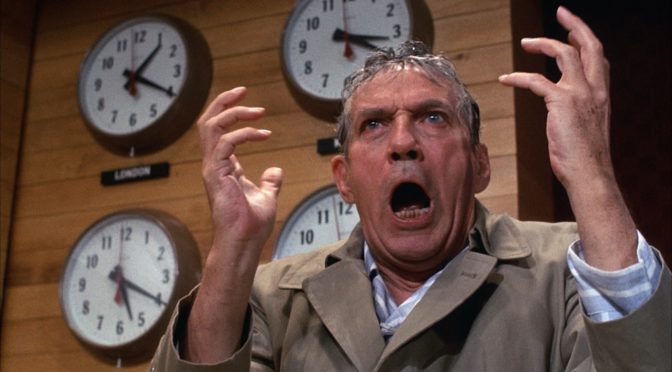
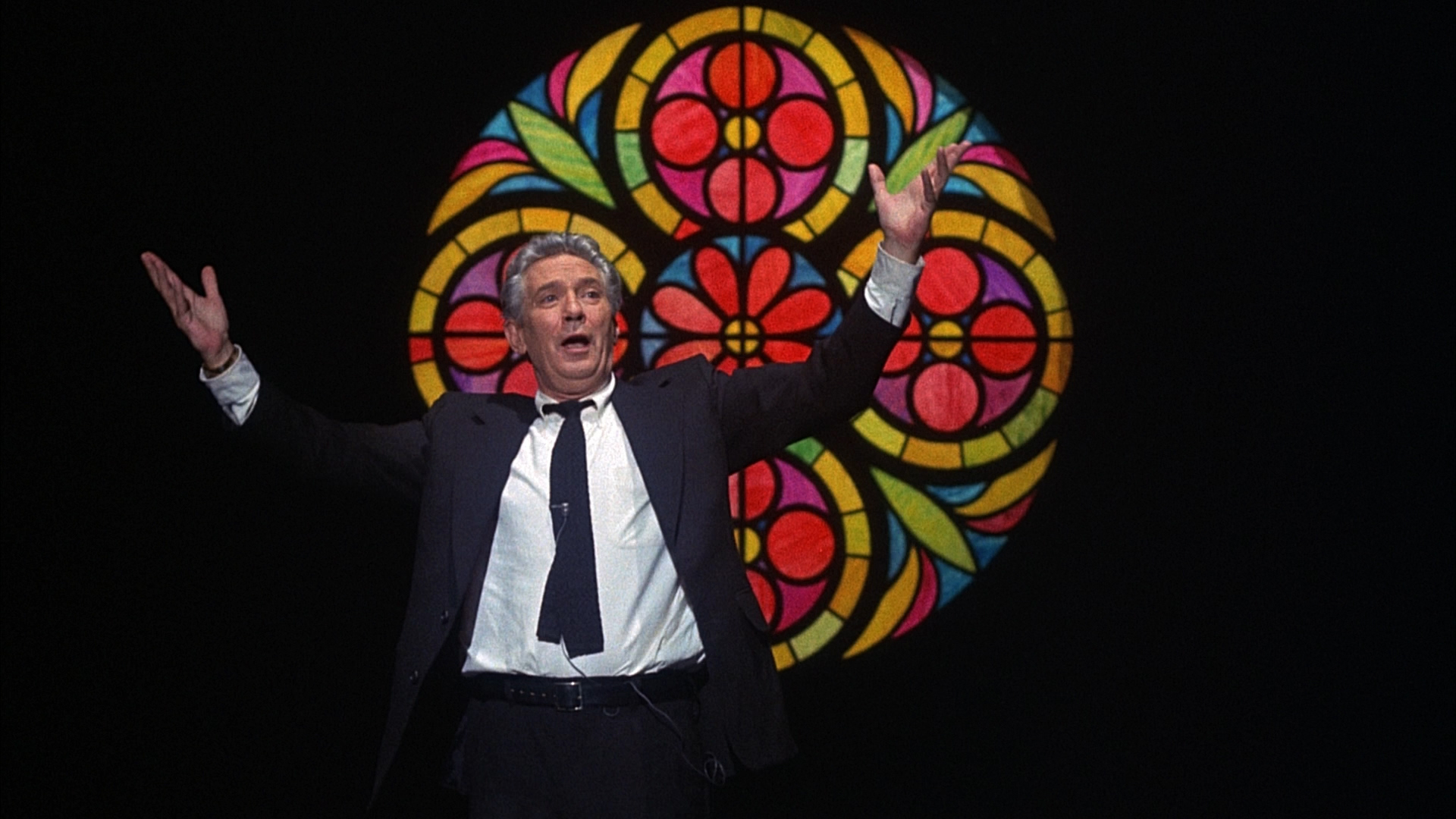
 Frank Hackett’s (Robert Duvall) character is also the future of television. He could not care less about the news division or even the quality of the network for that matter. He is a CCA (The Communication Corporation of America) man. This is the company that has purchased UBS and as far as Hackett is concerned UBS exists to serve the interests of CCA and it’s shareholders. And to that end he approves of Diana’s programming schemes once he sees the ratings skyrocket. Mind you, this film was made in 1976, years before all the cable “news” networks even existed and way before we had people willing to give up their privacy and what little dignity they have left on national television just to be recognized and become reality show “celebrities”.



 I didn’t expect a period price about 1970s TV news anchors to be funny. I remember seeing the previews back when Austin Powers was in his heyday thinking, “This is a cheap knockoff. Somebody trying to make money by getting in on a popular idea.” I didn’t even see Anchorman: The Legend of Ron Burgundy until relatively recently. But it immediately became one of my favorite and most quoted movies. It’s impossible not to laugh at this massive skit that is a perfect blend of left-field jokes and uncomfortable sexist humor. I was certainly not a Will Ferrell from the comedies he produced before Anchorman. I was so unimpressed by the Saturday Night Live skit based films that he did, like Night at the Roxbury, that Old School, Elf, and this film all flew under my radar. It wasn’t until I saw Stranger Than Fiction that Will Ferrell really got my attention and I began to look back through his filmography. And found that he has remarkable comedic timing and a way of fluctuating between over the top and deadpan deliveries that really translates well to the screen.
 But his crowning achievement is the creation of this fictional San Diego legend. You see, in the Seventies, men read the news. And the movie tells us that in San Diego, no one read it better than Ron Burgundy. In fact, he reads so well off the teleprompter that he’ll read anything (and I mean that). Burgundy rules the local news arena with the help of his crack news team. All men of course, but when the network forces the station manager (Fred Willard) to hire a female reporter, the sexy Veronica Corningstone (Christina Applegate), the men fall into a panic. And the world that they have come to know and love will never be the same.
 Anchorman is a wealth of wickedly stupid humor, the type that’s so dumb it could only ever be thought up by someone intimidatingly smart. That smart duet is Ferrell himself with his co-writer/director Adam McKay, who has teamed up with Ferrell three times since (Talladega Nights, Step Brothers, and The Other Guys). Ron Burgundy is hopelessly juvenile, terminally inappropriate, and so completely unpredictable that he’s also ridiculously funny. I will wager that this is the only film in which you will find someone shooting flames from the end of a jazz flute. But Anchorman is always willing to take things a few steps farther than you’d expect. The result is comedy which produces unstoppable belly laughs simply from the shock of where Ferrell takes the joke next.
 Possibly even more hilarious than Ferrell is his capable news crew. Steve Carrell as Brick Tamland repeatedly doubles me over with insane comments that seem to just come from out of the blue. He shouts, “LOUD NOISES!” when everyone else is in the station manager's office complaining about the addition of Corningstone to the news team. Paul Rudd’s reporter on the scene Brian Fantana is worth seeing just for his musk collection. Even Christina Applegate gets in a few good shots, because she is willing to dish out just as much as her fellow cast mates can throw at her. David Koechner is the weak point as the cowboy hat wearing sportscaster Champ Kind as he just made me uncomfortable. My biggest wish for this film would have been to see John C. Reilly in that spot.
 I get the feeling that half of this script was improvised on the spot, and that isn’t a bad thing. I wonder if once they got rolling on set, they just couldn’t stop. The talent pool on this cast was so deep, I can totally believe that at some point they simply abandoned the printed page after realizing they were coming up with better stuff just giving each other the giggles. And with cameos from people like Tim Robbins, Luke Wilson, Ben Stiller, Jack Black, and Vince Vaughn the comedy chemistry and laugh factor is wrenched up even higher.