A Movie That Changed Your Opinion About Something
 I have two films that have changed my ideas about the food industry. It has made me question everything I put in my mouth. These are the Morgan Spurlock McDonald’s experiment, Super Size Me, and Food, Inc. that asks how much we really know about the food we buy in the supermarket. After watching both of these movies, I wanted to move to a big 40 acre farm in Montana where my family and I could grow crops and raise cattle and we could seclude ourselves. Of course, then I got hungry and couldn’t afford to be a vegan, so I settled for a double cheeseburger.
Super Size Me had great concept that I wish I was clever enough to think of: Eat nothing but McDonald’s food for 30 days straight… breakfast, lunch, and dinner. He will follow three basic rules: (1) If McDonald’s doesn’t serve it, he can’t eat or drink it. (2) He must Super-Size his meal if asked. (3) He has to eat every item on the menu at least once during his 30 days. He claims to have gotten the idea when he saw a news item about two teenaged girls whose parents were suing McDonald’s for making them obese.
 This is an eye-opening and shocking look at the effects of fast food on the body, and it’s more important that ever with 60% of the United States being obese. We are literally eating ourselves to death.
Before he starts his experiment, he visits three doctors and has each of them conduct tests to get a baseline measurement of his health. He actually starts out healthier than average. He weighs about 185 lbs and stands at 6′ 2″. His cholesterol is well under 200 and his body fat is below 10%. The biggest surprise to me was the doctor’s nonchalance about his upcoming experiment. They predict minor effects: triglyceride levels will increase along with cholesterol. This suggests that even in the medical community, people didn’t know that too much easy cheap food is bad for you. Oh, and he won’t be exercising any of that fast food off, during the 30 days he will remain sedentary like most Americans.
During his first lunch, he sat in his vehicle with a Super-Sized Double Quarter Pounder meal. He is shown at 5 minute intervals attempting to complete his meal, which includes a 44 ounce Coke. He’s having a hard time, and at minute 22, loses it and vomits through the window and onto the parking lot. Gladly not every day was like this. By three days in, his mood is much better after his body adjusted to the high fat / high sugar food. Over the 30 days, he stops in for check-ups along the way. Nutritionists are surprised when he puts on about 10 lbs in one week. There are times in the 30 days that he feels palpitations, has trouble breathing, and feels constriction in his chest.
 A little over halfway through the month, the doctors finally catch on to the danger and indicate that the side effects are going far beyond what they predicted. His triglycerides and cholesterol are up, but his liver also looks like he has been a heavy drinker all his life. By the end of the 30 days, he’s put on almost 25 lbs, and his body fat has increased from 10% to 18%. In the closing credits, we’re told that it took him 8 weeks to get his liver back to normal and over one year to get down to his previous weight.
Shortly after Super Size Me was released, McDonald’s announced it was going to discontinue its Super Size menu. They of course denied it had anything to do with the film. I would suggest you to buy this one so you can pop it in whenever you get that fast food craving and remind yourself that it is terrible, or you can watch the whole film online or from Hulu.
 I consider myself pretty well educated when it comes to nutrition. I mean, I actually read and understand most of the stuff that is put on the nutrition labels. But I was shocked when I watched Food, Inc. and found out that some of those items that I thought were healthy could have been doctored to the point that they harbor franken-bacteria. And if I was this taken aback, I can imagine how many people who don’t take the time to educate themselves would really be stunned if they realized where their food comes from and what the food they are consuming could be doing to their bodies. Most Americans biggest concern about their food is that it is fast, cheap, and tasty. Food, Inc. examines the costs of valuing cost and convenience over nutrition and environmental impact.
Director Robert Kenner explores the profitization of food from all angles. He talks to authors like Eric Schlosser (Fast Food Nation), who happened to co-produce the film, and Michael Pollan (The Omnivore’s Dilemma). And he follows the story of farmers like Gary Hirschberg (Stonyfield Farms) and food standards advocates like Barbara Kowalcyk, who has been lobbying for more rigorous procedures since her two-year-old son died from E.Coli found in meat that was recalled 16 days after he had already passed. He takes his camera, much like Upton Sinclair, into slaughterhouses and factory farms where chickens grow too fast to walk properly, cows eat feed pumped with toxic chemicals, and illegal immigrants risk life and limb to bring these products to market at an affordable cost. Kenner presents this expose in such an engaging way that Food, Inc. it is relateable and accessible to the over-scheduled American who doesn’t have the time or income to read every book or to make sure that they aren’t eating eat non-genetically modified produce every day.
Food, Inc. isn’t quite as entertaining as Super Size Me, but I believe it made a bigger impact on me and although I am not as paranoid as the film probably wants me to be, I still think of these films every time I bring the fork to my lips. So how about you? Are there any movies that have changed your mind about something? Perhaps you hated blue people until Avatar showed you that they have a softer side? Let me kno in the comments below or on Twitter or Facebook.
 This was another category that suffered from the use of vague language. What is a classic movie? What criteria would you use to define a classic? I think what determines a classic film is the same thing that determines a classic piece of literature: the test of time. No film or literature of substandard quality will survive that test. The key to passing this test of time is a work’s universal appeal. This asks for my favorite, not the most classic, so I am pleased to share my favorite classic movie, North By Northwest.
 The 1950s were a great decade for Alfred Hitchcock. He had so many hits with Strangers on a Train, Dial M for Murder, Rear Window, To Catch a Thief, and The Man Who Knew Too Much. He also had a TV show, Alfred Hitchcock Presents. But in 1958, Vertigo was released and failed to impress critics or audiences. Hitchcock was undoubtedly disappointed by this and couldn’t know that Vertigo would eventually be considered one of his masterpieces. But he vowed that his next project would be a more tested and tried effort that would be more of a crowd-pleaser. The film was a box-office hit, second only to Ben-Hur for the year, and got positive reviews from critics.
 It starred Cary Grant as Roger Thornhill a New York advertising executive who is mistakenly identified as a secret government agent, this put a target on his back. Then he’s framed for murder, this puts him on the run from the police as well as the bad guys. While on the run, he meets Eve Kendall (Eva Marie Saint), who apparently believes his story and wants to help. I’m not going to give you any more about the plot because I want everyone to see it. It has so many iconic scenes and it is still powerful today. It influenced a whole genre of action-suspense-espionage movies. Only three years after its release, the first James Bond film, Dr. No, appeared. Of course, James Bond is a spy, whereas Roger Thornhill was only mistaken for one. But both films have implausible action sequences in outrageous locations like Mount Rushmore. They both have beautiful but mysterious women who take an interest in the hero. And both have a well-dressed leading man who is suave, has a knack for one-liners, a fondness for liquor. You can probably think of dozens of movies since 1959 that have operated on those same principles.
 With North by Northwest, Hitchcock tweaked the basic man-on-the-run story with witty dialogue, charismatic performances, and visually arresting action sequences. He demonstrated that these elements of basic popular entertainment, which are sadly looked down upon by some who call themselves critics, could be applied to big-budget studio films. He showed that a movie could be entertaining, thrilling, and funny, smart and well-produced. It didn’t have to choose to be either high-brow or low-brow. North By Northwest is an extremely entertaining thrill ride. There is not a lot of substance or meaning to it, it is just a tremendously fun roller coaster ride that Hitchcock takes us on. When I first saw it as a kid, I was hooked. And it set a precedent for hundreds of blockbusters that followed in its wake.
  Growing up, I remember getting to go to work with my dad from time to time. My dad has worked for several different companies, from pest control to shoe repair, but I will never forget the day that he took me to work with him at the radio station. He sold airtime to businesses that wanted to advertise on the station. I got to sit in the booth with the Djs, I even recorded a little radio spot when I was probably no older than 4 or 5 for the station that used to be GC-101.
 This one was a fairly easy choice. I don’t tend to re-watch many movies, only those that I really enjoy. But I remember seeing Braveheart in theaters three times when I was only 12. That means that begged my parents or friends parents to take me because I was too young to go by myself. This was the first DVD I ever bought. I watched it so many times in High School that I now have the movie memorized. I’m not sure of my heritage, I’ve never done the ancestral digging to find out where my origins truly lie, but because of this movie, I tell people I’m Scottish. And I am proud to be a Scotsman.
 It probably had something to do with the gory violence, and the comedic writing probably helped as well. But what really got me, I think, was the fact that I was able to lose myself in the film and become William, joining him on his journey.
 Looking back, it has been a while since I sat down and critically watched this film. It does suffer a bit from it’s length as it tends to drag a bit in the 2nd and 4th acts. That would be the background story of Robert the Bruce (little known fact: the title Braveheart was historically attributed to him, not Wallace.), and the love affair with the princess, which is total historical rubbish (she would have been in France at the time and only about 13 years old) and completely unnecessary, and contrary, to the heart of the film. That being said, this is still a film which I plan on showing to my sons and daughter when they are on the brink of the teenage wasteland. I hope that it can teach them what it taught me. That a life that is lived without purpose is not lived at all.



 I am six days into the 30 Day Movie Challenge and I have remained faithful. But today presents a couple of obstacles. First, it is Wednesday and this is the one day a week that I take my kids to school. I choose Wednesday because that is Chapel day and I can sit with them as they sing and dance. It reminds me of an opening rally at VBS. I am writing this as I wait for chapel to begin, but this will delay me from my blogging time until about 10am. Add to that the very obscure topic for today, and it really does present a challenge.
 I Know My Name is Steven was one that looked interesting, also
  The story-lines involving Porter’s customers and how their lives were changed by him are certainly inspiring, but one must also wonder if they actually did happen. I was most intrigued by the story-line involving the gay couple and an obvious insinuation that one of their friends might have been afflicted with the AIDS virus. This was never resolved and seemed a little misplaced. Also, what is probably the films most quotable line, “God created us all, Shelly. He doesn’t make mistakes,” is in relation to this couple. The fact that this little bit of tolerance propaganda was tagged on kept this from being a really great film. But it doesn’t keep Door to Door from being a really an inspirational story that I still recommended for those who are sick movies about things getting blown up or people getting peppered with bullets.
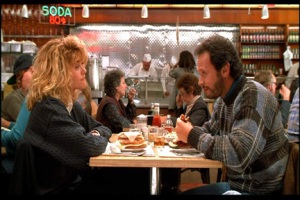 I can’t say that I’m an expert on romantic novels or films. I’ve seen my fair share, but I am not as fond of this genre as some others may be. That being said, I believe that When Harry Met Sally is, the wittiest and most funny romantic comedy out there in film land. The movie came out in 1989, but for some reason, I think this is one that will stand the test of time and entertain audiences for decades to come.
 Their love story is one that we’ve seen play out on the screen dozens of times since, but I don’t think any film has ever or will ever portray the issue better. The question it poses is one of universal importance, namely, can women and men ever be friends? It appears so, but what happens when you introduce sex to the equation? Does it negate the friendship or does the intimacy make it too awkward to continue just being friends? I’ll leave that for you and your friends (male or female) to discuss over a nice cup of coffee. If you haven’t seen the film, go now and watch it. Seriously, I will wait right here. If you won’t go watch it, I’ll just say that with heaps of quirky, funny dialogue, a script that Nora Ephron will forever attempt to duplicate, and clean directing from the extremely talented Rob Reiner, When Harry Met Sally is a highly enjoyable film that has held strong over two decades after its creation.
 In contrast to many of the weeping romantic comedies and melodramas that I mentioned in yesterday’s
  I don’t watch movies that make me sad. The reason most people watch movies is to escape for a couple of hours from your life. Who wants to escape to a sad alternate reality? On the other hand, there are plenty of movies with sad elements or scenes that make me cry no matter how many times I watch them. Yeah, that’s right I cry at movies. But that sadness is usually part of an ultimate happy ending or uplifting message.
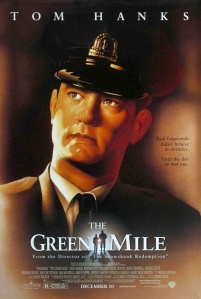 To narrow it down, I thought of 5 sad movies that I had seen. Those 5 were: My Girl, Boy with the Striped Pajamas, Dead Poets Society, A Walk To Remember, and The Green Mile. The saddest movie that I could think of was The Green Mile. At John Coffey’s execution everyone is weeping at seeing something so unjust. Everything from the scene where Paul goes into John’s cell and asks him what he wants him to do is sad. He can’t bear the thought of killing “one of God’s true miracles.” He doesn’t want to stand before God at the judgment and have to answer for why he killed an innocent man. Then as John asks to see a movie, he sits amazed at the beauty that he is beholding. At the execution I have to stop myself from sobbing out loud. Even the ending when we see Paul as an old man grieving over the loss of a friend saying that this is his punishment killing John Coffey. For those that think Stephen King is only a horror author, this film is the answer to that.
 If we’re going off of pure funniness, then the winner would be Blazing Saddles. I must admit that I saw this movie at much too young an age. I was a latch-key kid, spending several hours alone at home every night after school before my Mom and Dad got home from work. That gave me time to explore my parent’s collection of films. I probably saw this before I turned 12, but growing up in a town that is still to this day visibly divided by the railroad tracks, I understood the racial dynamic. I probably shouldn’t have been allowed to see it till High School, but I don’t think I was irreparably damaged. This is one of those films that has entered my vocabulary, one that my dad and I quote back and forth… “What’s a dashing urbanite like you doing in a rustic setting like this?”… “They darker than us!”… “Oh, lordy, lord, he’s desperate! Do what he sayyyy, do what he sayyyy!” Even though this film contains innumerable racial slurs, I think the point (if it has a point) is really about racial equality. The film is also quick to make references to other films and actors to make some of its gags. And since this was one of the few comedies in that home video library, I would watch it over and over again and was forced to do research on some of the jokes (Hedy Lamar, Randolph Scott, Cecil B. DeMille). Because of that, I owe a great deal of my love for film to this movie because it started me digging into the film industry.
 Standing in stark distinction to Blazing Saddles, I didn’t see The Princess Bride until I was in college. It is a movie that my kids have already seen and is also tremendously quotable. It has everything; action, adventure, humor, pirates, torture, and of course, true love. Cary Elwes delivers the most outstanding performance of his career as Westley, the love-struck servant to Buttercup (Robin Wright), a beautiful woman living in a misty romantic fantasy world. She also gives one of the best performances of her career in her film debut here as Princess Buttercup. The thing that makes this movie so great is the quality of comedy relief of the entire supporting cast. Wallace Shawn is absolutely hilarious as Vizzini, the bonehead villain who is completely convinced that he has the whole world figured out, Andre the Giant delivers a lumbering but highly impressive performance as Vizzini’s enormous, idiot sidekick, and my personal favorite, Mandy Patinkin creates one of the most entertaining and likeable characters to ever see the screen. “My name is Inigo Montoya! You killed my father! Prepare to die!”
 Fred Zinnemann is one of the great forgotten directors, which is amazing considering that he was nominated for eight directing Oscars in four decades and won two. We don’t hear today’s directors idolizing him or many critics championing his work. You will probably never read about him in “Entertainment Weekly.” For Zinnemann, the script is king, and his greatest genius may have been in choosing the right scripts and knowing how to do them justice.
 Paul Scofield plays More in such a way as to make us not only admire him but identify with him. As we watch, we come to value both his humanness and his spirituality. His tired eyes, the way he gently rebuffs his opponents, his genuine professions of loyalty to Henry even as he disagrees with the matter of his divorce, all help to create a character so well-rounded and illuminating that we find him to be better company than the people we meet in real life. It’s a gift the movies seldom actually deliver on, so when someone like Scofield makes it happen, we respond with admiration and gratitude.