Roger Ebert – Labyrinth – 1986:
Roger Ebert – The Man Who Fell to Earth – 2011:
The world lost one of its true creators this weekend. David Bowie was a perpetual outsider, ahead of the curve. He made a career and a life out of living outside the norm as an alien, a misfit, a sexual adventurer, a faraway astronaut. His first film, The Man Who Fell to Earth has become a cult classic. I regret to say that I have not seen it, but hope to rectify that shortly. In the film, he plays an alien from a drought-stricken planet who journeys to Earth in search of water. Ebert remarks, “Bowie, slender, elegant, remote, evokes this alien so successfully that one could say, without irony, this was a role he was born to play.” Ebert remarked about meeting David Bowie and about his quality as an actor.
[He] has an enviable urbane charm. I met him once, and rarely have been so impressed by someone’s poise. If he hadn’t been a rock star he could have had success as an actor, playing roles such as those given to James Fox or William Hurt. Bowie demonstrated that in such films as “Merry Christmas, Mr. Lawrence,” “Absolute Beginners,” “The Hunger” and “Labyrinth.” … He is … Other. Apart. Defined within himself.
Besides his progressive, challenging, and remarkable body of work, Bowie also gifted us with his son with Mary Angela Barnett, Duncan Jones, who I believe is one of the most promising up and coming directors working today. He directed two sci-fi thrillers, Moon (2009) and Source Code (2011). Bowie has had such an impact on our popular culture and he held such respect from such a wide array of people, receiving memorial tweets from people like Madonna, Astronaut Tim Peake, Kanye West, and even the Archbishop of Canterbury Justin Welby. The world will be a slightly less interesting place with him gone.
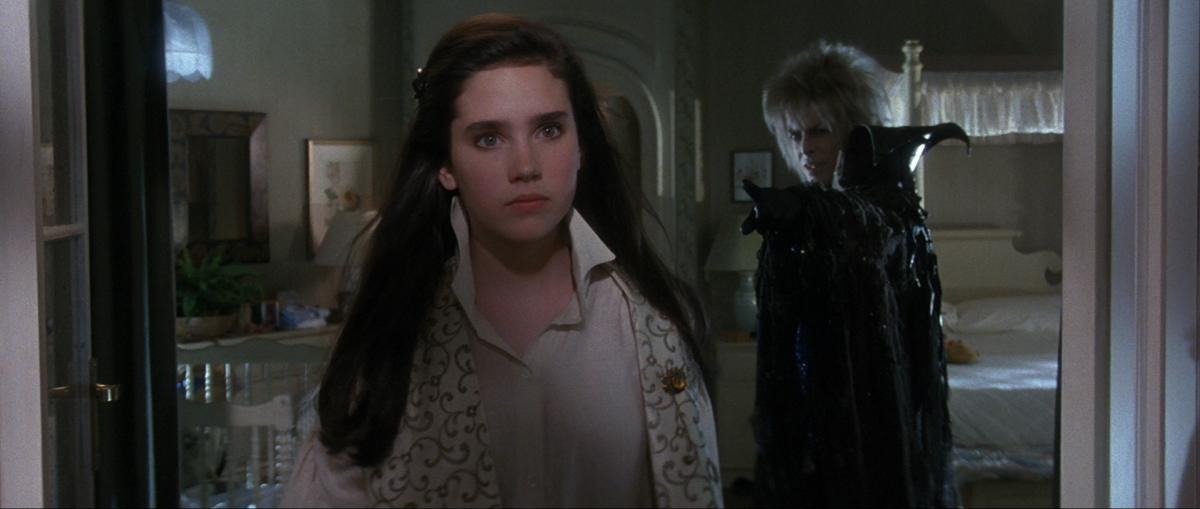
 As I have read and heard so many people speaking fondly of him, I felt compelled to share my first memory of David Bowie. It was in the 1986 film Labyrinth, I was too young to remember seeing it when it first was released, but I recall renting the film from our local video store and watching raptly as a Sarah (Jennifer Connelly) struggled on a magical adventure to rescue her brother from Bowie’s deceptions as the goblin king Jareth.
Bowie joined forces with Muppet creator Jim Henson, special-effects guru George Lucas, and screenwriter Terry Jones of Monty Python fame to produce this fantasy which reminds me of a strange blend of The Wizard of Oz, Alice in Wonderland, and Maurice Sendak’s Where the Wild Things Are.
It was a great work of Jim Henson and very ambitious. To my young mind it was a swirling and thrilling adventure. Unfortunately, I think I may have lost some of the youthful exuberance that I once possessed, because upon a re-watching a year or two ago, I was amazed at how meandering and drawn out the film is without good reason. It is longer than it should be and is lacking enough of a coherent plot to keep me attached. However, I may still dust it off again, if just to hear the soundtrack as Jareth himself composed and performed a number of songs for the film. Farewell Major Tom, God’s love be with you.
[spotify id=”spotify:user:spotify:playlist:7MQd3rOe8kuP2KDjtuiynJ” width=”300″ height=”300″ /]
 You would think that with 20 years to work on a worthy follow-up to the Indiana Jones Trilogy that Steven Spielberg and his collaborator George Lucas could create an entertaining and exciting film. However, it seems that instead of becoming sweeter with time, this one just became rotten. In Indiana Jones and The Kingdom of the Crystal Skull, we see an elderly Indy (or should I say Henry because he is rarely called “Indiana” or “Indy” in this film) in his baggy grandpa pants with locks of grey-white hair peeking out under a crisp and rarely-dirty brown fedora you really don’t get the feeling that you’re watching anything historic. This is a movie that obviously misunderstood its audience, it’s exactly the type of summer blockbuster developed to make money at all costs: things blow up; there are aliens; and an unnecessary youthful sidekick.
 The other aspect of the film that disappointed me was the role that extra-terrestrials play. The original trilogy uses religious artifacts as the treasure the Indy is hunting. But as with the abominable Star Trek prequels that George Lucas thrust upon audiences, all of the religion and mysticism was replaced by science-fiction. Why don’t film-makers understand that audiences want to encounter something inexplicable in the theater. We don’t want midichlorians to give a scientific explanation of the force or science to replace our religion. The presence of the aliens is strong, but there is no dialogue between the two parties, much like Spielberg’s Close Encounters of the Third Kind.
 Ultimately, Indiana Jones and the Kingdom of the Crystal Skull is a film that, while not entirely bad, is nowhere near worthy of its lofty pedigree. As generic action films go, it may have provided some level of entertainment in the vein of National Treasure..But with the attachment of “Indiana Jones” to the title and the involvement of Harrison Ford, George Lucas and Steven Spielberg my expectations were raised and my standards were set to a level that these individuals can sadly no longer meet.