Favorite Animated Film
 Being a dad, it seems like I watch more animated movies than any other type. And since I am a film snob, I can’t stand to endlessly re-watch sub-par movies the way that I see so many parents do. Just because Cars is my kids’ favorite Pixar movie, that doesn’t mean that I am going to put it on every time they ask to watch a movie. Although they would be happy with that, I would go insane. And even if it was a good movie, it would lose some of its magic after seeing it twice a week for 3 years. I am constantly looking for good animated films to share with my family. That passion, along with my general love for film, led me to the breathtaking and impressive canon of Japanese hand-drawn animation director Hayao Miyazaki.
Now 70 years old, he is often referred to as the Japanese Walt Disney. He has directed ten feature length animated films as well as several shorts and Japanese television shows and personally hand drawn tens of thousands of frames. I know that most Americans don’t think to highly of “Japanimation,” as it has been called. I can’t say that I blame them. Run of the mill “Japanimation” is irritating, overly violent, raunchy, indulgent, and devoid of good storytelling. But that description could be used to describe most modern American fare.
 But Miyazaki is a glowing exception. His animation has an attention to detail that rivals the exacting standards of a company like Pixar. His intense yet delicate shading of colors would make his works of art more at home in a fine art gallery than in the Sunday comics. Miyazaki also has a great sense of humor, a gift for poetic storytelling, and a taste for adventure. His beautiful children’s movie, My Neighbor Totoro, is a charming and deeply affecting look at how a child’s imagination helps her endure a time of private fear and sadness. His most recent work, Ponyo, is a beautiful story of the transforming power of love. Princess Mononoke, is a powerful, sprawling epic about the need for humankind to respect and live in harmony with the environment. And that is a message that people of all faiths should proclaim.
I almost chose Princess Mononoke, but decided to go with what is widely considered to be Miyazaki’s masterpiece. Spirited Away combines the weighty mythologizing of Mononoke with the playful spirit of My Neighbor Totoro, but then goes in new directions as well. It is funny to me that Walt Disney Studios has helped bring Miyazaki’s features to American cinemas, because Miyazaki’s work tends to reveal that most Disney films are simplistic and predictable.
 Spirited Away is a coming of age story of a little girl named Chihiro, who gets lost in a wonderland of spirits and witches, and her quest to find a way to break the curse that has transformed her parents so they can return home. Her only friend in this world is a mysterious boy named Haku who helps her to survive. Eventually we come to hope that Chihiro, her parents, and Haku will all eventually break away from the harsh tyranny of the powerful and dictatorial witch Yubaba.
The secret to their freedom lies in discovering their true identities. Yubaba gains her power and control over her subjects by stealing their identities, much like Ursula in The Little Mermaid. Yubaba can hold her own with the most memorable wicked witches of all time. She’s wider than she is tall, her head makes up half her body, she has snake-like shoots of white hair bound up in a bun, and her massive nose bulges out before her like a weapon. She snarls and cackles her way through the film. 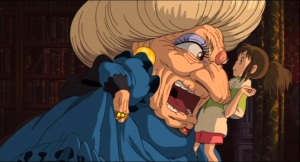 One of the things I love about Miyazaki is that he never sets up a simplistic face-off between good and evil. He knows we all have good and evil within us, and thus his “villains” have moments of kindness, and his heroes do things they regret.
If the film sounds complicated, it’s because it is. This film runs just over two hours, but with its fast pace and a plethora of subplots Spirited Away feels like Miyazaki decided to challenge George Lucas at his own game of exotic adventure and whimsy. There are enough bizarre creatures here to make the cantina in Star Wars look boring. The depth and fertility of Miyazaki’s imagination leaves me stunned at every turn.
 Some will say that this film is too complex for children, and too scary. For small children, possibly. They could get lost in the intricate plot, and the monsters might scare them. I personally showed it to my kids starting at age 5 and up. But I think kids should be challenged to think through what they’re watching, and this is a story that provides great opportunities for discussion with grownups. Spirited Away is at times frightening, but it emphasizes the importance of an individual’s virtue, and affirms that the smallest of characters can make a big difference. It offers powerful displays of sacrificial love. And it, as I mentioned before, portrays “villains” who are redeemable and can be transformed by compassion and kindness.
Many Christians will probably berate me for my love of this film calling it occultic. But Miyazaki comes from a culture that is steeped in Shinto mythology and beliefs about the spirits of nature and of the dead. So of course, his story reflects such traditions and beliefs. But he is not “preaching” these ideas any more than Jiminy Cricket is preaching astrology when he croons about wishing upon a star. He is treating them as myth, as fantasy, and using them to illustrate lessons and morals that open-minded Christians will find quite similar to their own. The film makes no mention of “God” or any benevolent force which rules the world, but it does affirm the importance of personal virtues like: selflessness, sacrificial love, humility, friendship, compassion, and courage. People of any faith can read these characters as symbolic, and the story reflects powerful truths.
 One spirit in particular, No Face, appears at first to be gentle and friendly. But he becomes more and more mysterious, shifting between gentleness and violent destructive behavior. Eventually, we come to understand that he is a lonely spirit who seeks approval. When he is around greed and evil, he responds with greed and evil. But when he is offered friendship and unconditional love, he seems to try a better path. Chihiro has patience with him and her kindness reminds me of how Christ patiently endures with me in my own tendency to become self-absorbed. He waits patiently, always offering love, forgiveness, and direction to a better way. No Face is amazed at Chihiro’s virtue. And I came to hope that he would abandon his violence and follow Chihiro to a better life. This is just one of many such parables within a vast tapestry of interconnected stories.
All in all, this is an absolute must-see. And the bigger the screen the better. The colors are incredible, from shots of a magical train that skims across the sea, to fantastical gardens and intricately painted murals. Well, I’ve said my piece. What is your favorite Animated movie? Do you love Miyazaki’s work as much as I do, or do you have another opinion. I’d love to hear your thoughts in the comments below or on Twitter or Facebook.
 It’s the mark of a great documentary that it can make you care about something you had no interest in otherwise. That is the reason I loved this documentary, because the fight between Billy Mitchell the jerk and underdog Steve Wiebe is something utterly captivating, and a story that’s continued even though the movie came out in 2007. That’s right, the two are still competing, and the saga continues. Sure, it might not seem like a big deal to us, but to these guys, it’s everything.
 Mitchell’s record stood, undisturbed, until 2005. That’s when Steve Wiebe, who had recently been laid off, decided to accept the challenge to compete with Mitchell’s high score. The most amazing part of the film is the fact that Wiebe’s wife and kids let him engage in what is a very trivial competition.
 But he is one of the best villains I have seen on the screen in a long time. Wiebe, on the other hand, is a guy you can’t help but pull for. We cheer when he bests Mitchell’s score by over 200,000. Then we feel his setbacks when the score is invalidated.
 No, I didn’t mis-count, it is still day 20. Yesterday I stretched this question into two questions by naming
  My favorite modern actress is another tough decision. The leading lady I picked has been very selective in her roles. She started her career at 12 years old by getting herself kidnapped by a hitman named Leon. She would go on to get her Bachelor’s degree in Psychology from Harvard University, and become the Queen of Naboo and a representative in the Galactic Senate. But Natalie Portman really caught my eye when she shaved her head and learned an English accent to play Evey in the futuristic V for Vendetta. She is the accomplice to V, a masked and mysterious anti-hero who’s either a terrorist or a freedom fighter, depending upon which side of the explosion you’re on.
 This category is very close to what could be another category. It would be a similar category but I think the results would be very different. That category would be looking for the best book that has been adapted to a film. Since this is a movie challenge, it is only right for the questions to focus on a film instead of a book. My favorite book that has been turned into a film is the Lord of the Rings, but my favorite film (that happens to be adapted from a novel which I have never read) is One Flew Over The Cuckoo’s Nest (1975). It was the first film to sweep the 5 major awards at the Oscars: Best Picture, Actor, Actress, Director, and Screenplay since Frank Capra’s It Happened One Night did it 41 years earlier.
 This rebellion is at times uplifting and we cheer as we see these patients grow, but at other times it’s destructive especially during the ending of the film. Nurse Ratched is often portrayed as an unflinching power hungry authority figure. But in her own way, she does seem concerned for the well being of her patients.
 As I said before, I have not read Ken Kesey’s acclaimed novel, so I cannot judge the film as based upon the book. In my opinion, it is a fruitless endeavor to compare a film and a book, they are distinct forms of art and have their own advantages and drawbacks. That being said, one way to judge the quality of an older film is to look at some of the supporting cast that Found their fame by using the film as a diving board. This one produced a few, namely Danny Devito and Christopher Lloyd. Do you have a favorite film that is based upon a book or some other form of literature? I’d love to hear your picks or you can comment on One Flew Over The Cuckoo’s Nest if you have seen it. You can leave your comments below or on Twitter or Facebook.
 Today’s challenge was simple. If I can only recommend one movie to anyone, it is this delightful gem from Roberto Benigni. And it is a rare occasion that they have already seen it. I wonder what prevents people from seeing this film. Is it the fact that it is a foreign film or maybe that there are no recognizable movie stars in it? Perhaps it is the fact that the subject matter is generally so depressing. But the funny yet haunting Life Is Beautiful, is quite possibly the best most satisfying movie I have ever seen.
 Fast-forwarding a few years, Guido, now owns a small bookstore. Guido and Dora have married and have a young son. It wasn’t until writing this review that I found that his son’s name is “Joshua” spelled Giosue (Giorgio Cantarini). A Nazi presence is now creeping into their Italian town, and signs have begun to appear in shop windows: “No Dogs or Jews Allowed” Guido, who we learn is Jewish himself, jokes to a confused Giosue that he should put up a sign on their store: “No Spiders or Visigoths Allowed.” The film shifts gears when his family is arrested and sent to a concentration camp. Dora, who is not Jewish, chooses to follow her husband and child. It is at this point that Life Is Beautiful changes into a very different film. I was impressed at how seamlessly the comedy moved into the world of the death camps.
 You would think that with 20 years to work on a worthy follow-up to the Indiana Jones Trilogy that Steven Spielberg and his collaborator George Lucas could create an entertaining and exciting film. However, it seems that instead of becoming sweeter with time, this one just became rotten. In Indiana Jones and The Kingdom of the Crystal Skull, we see an elderly Indy (or should I say Henry because he is rarely called “Indiana” or “Indy” in this film) in his baggy grandpa pants with locks of grey-white hair peeking out under a crisp and rarely-dirty brown fedora you really don’t get the feeling that you’re watching anything historic. This is a movie that obviously misunderstood its audience, it’s exactly the type of summer blockbuster developed to make money at all costs: things blow up; there are aliens; and an unnecessary youthful sidekick.
 The other aspect of the film that disappointed me was the role that extra-terrestrials play. The original trilogy uses religious artifacts as the treasure the Indy is hunting. But as with the abominable Star Trek prequels that George Lucas thrust upon audiences, all of the religion and mysticism was replaced by science-fiction. Why don’t film-makers understand that audiences want to encounter something inexplicable in the theater. We don’t want midichlorians to give a scientific explanation of the force or science to replace our religion. The presence of the aliens is strong, but there is no dialogue between the two parties, much like Spielberg’s Close Encounters of the Third Kind.
 Ultimately, Indiana Jones and the Kingdom of the Crystal Skull is a film that, while not entirely bad, is nowhere near worthy of its lofty pedigree. As generic action films go, it may have provided some level of entertainment in the vein of National Treasure..But with the attachment of “Indiana Jones” to the title and the involvement of Harrison Ford, George Lucas and Steven Spielberg my expectations were raised and my standards were set to a level that these individuals can sadly no longer meet.
 Yikes! I only have an hour to give you this day’s challenge before my carriage turns into a pumpkin. There is that word “hate” again. As I said a few days ago, hate takes too much energy. These are movies that I used to like but have put out of my mind or forgotten about. When looking back at some movies that I enjoyed in my childhood and youth, I was amazed at how many I still enjoy. I didn’t watch most of the crap that passed for film in the late 80s and early 90s. But one of the films that I kept coming back to was Batman and Robin. I mean, George Clooney with bat-nipples and two inept sidekicks. I probably watched it originally because I loved Alicia Silverstone. But I could really just say any Batman film made in the 90s. That’s right, even Batman Returns. The first Tim Burton Batman was tolerable, but having seen Batman Begins and The Dark Knight, even it has lost a great deal of its original appeal.
 Considering my current line of work, my mind immediately went to two films about security guards. Paul Blart Mall Cop and Observe and Report. In case you don’t know, I work security for UPS at their Worldport facility. But I don’t take my job as seriously as either of those characters. Then I thought of the numerous caricatures of ministers in popular culture and couldn’t in good faith (pardon the pun) align myself with the likes of the cross-dressing, peep-show visiting, homicidal Rev. Peter Shayne (played by Anthony Perkins) in Crimes of Passion, to the faith-challenged Father Karras in The Exorcist, and the fornicating Rev. Russell in Simon Birch. If I could choose a television character, I might pick Rev. Camden from 7th Heaven. I always liked him.
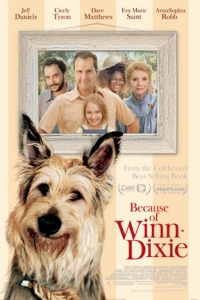 The best portrayal of a solid, faithful movie pastor that I have seen in recent years was Preacher from Because of Winn-Dixie. Played by Jeff Daniels, Preacher is a deep character with personal problems. He was abandoned by his wife because she no longer wanted to be married to a pastor, now he is lonely. He loves and wants to care for his little small-town flock. He has a sincere desire to find ways to make God’s Word meaningful to his congregation, and buries himself in his work. Because of this, he frequently lacks time for his daughter, but we can tell that he deeply loves her. He gets angry. He is unashamed to pray in public. In other words, he is human. He is flawed, but he is trying to do what is right. It is a shame that characters like Preacher, who accurately reflect many pastors, emerge so infrequently in film. But the fact is, most of the time, pastors simply don’t exist in the landscape of film. When these pastors do not appear where they should in the cultural landscape, it conveys the idea that they are irrelevant, inconsequential, or worse, completely absent from thought. The assumption is that pastors are unnecessary.
 At this junction of my life I feel like an average Joe. I frequently give advice to a group of misfits. I’m a funny guy who tends to take a laid-back approach to life. With that being said, I can relate to Peter LaFleur from Dodgeball: A True Underdog Story. Peter La Fleur, played by the excellent Vince Vaughn, operates a small gym called Average Joes. The opening scenes in Average Joes could have very well used the theme song from the television sitcom, Cheers, a place where everybody knows your name. Too bad Peter has been too busy developing genuine friendships to hone his business sense. Average Joes is in foreclosure unless they can come up with $50,000. To do this, these averages will have to become something extraordinary. And Peter La Fleur must step out in faith, and put everything of value to him on the line.